Table of contents
- Why the 7Cs of Communication Still Matter Today
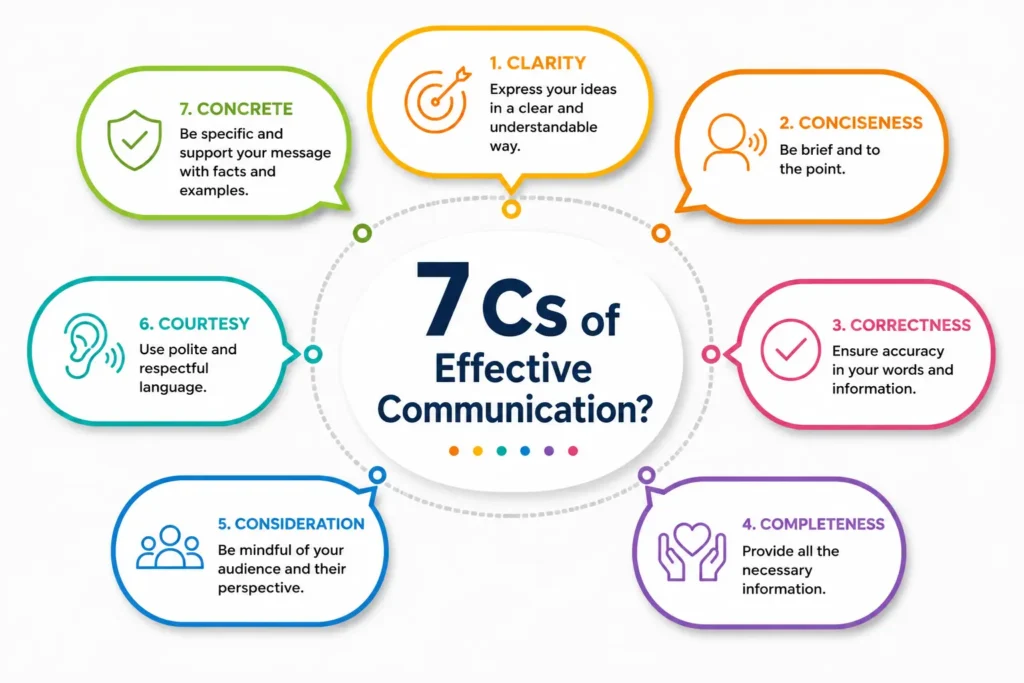
- Quick Reference: The 7Cs of Communication at a Glance
- 1. Clarity
- 2. Conciseness
- 3. Concreteness
- 4. Correctness
- 5. Coherence (also called Consideration or Consistency)
- 6. Completeness
- 7. Courtesy
- How to Apply the 7Cs of Effective Communication in Your Daily Life
- Frequently Asked Questions
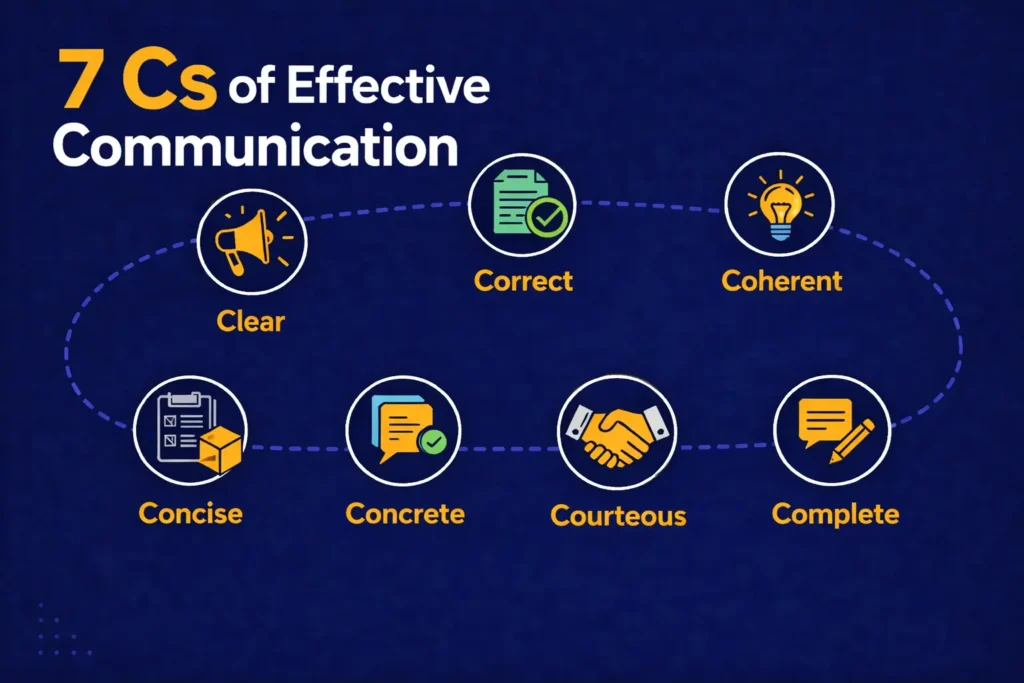
Whether you are writing a business email, presenting to a client, or having an everyday conversation, the quality of your communication determines how well your message is received. The 7Cs of effective communication is a widely taught framework that outlines seven core qualities every effective message should have. First introduced by Scott M. Cutlip and Allen H. Center in their 1952 book Effective Public Relations, the model has since become a cornerstone of communication studies, business training, and academic curricula around the world. So, what are the 7Cs of effective communication? They are: Clarity, Conciseness, Concreteness, Correctness, Coherence, Completeness, and Courtesy. Each one targets a specific weakness that can cause communication to fail — from vague language and factual errors to poor structure and disrespectful tone.
In this guide, we will walk through every one of the 7 Cs of communication in detail. For each principle, you will find a clear definition, a real-world example, common mistakes to avoid, and actionable tips you can apply immediate.
Why the 7Cs of Communication Still Matter Today
In an age of instant messaging, short-form content, and information overload, poor communication has very real consequences. Misunderstood instructions cause project failures. Rude or careless messages damage professional relationships. Vague writing wastes time and creates confusion.
The 7 Cs framework addresses all of these challenges by giving communicators a practical checklist to evaluate their messages before sending them. It is equally applicable to written communication (emails, reports, proposals) and spoken communication (presentations, meetings, phone calls).
Research consistently shows that employees and leaders who communicate clearly are more trusted, more productive, and more successful in their careers. Understanding the 7 cs of effective communication is therefore not just an academic exercise — it is a practical professional skill.
Quick Reference: The 7Cs of Communication at a Glance
1. Clarity
Clarity means expressing your message in a way that is easy to understand. A clear message uses simple, direct language and avoids ambiguity. The reader or listener should not have to guess what you mean.
Lack of clarity is one of the most common communication failures. When a message is unclear, the recipient either misunderstands it or has to ask for clarification — both of which waste time and can create frustration.
What Clarity Looks Like in Practice
Clarity is achieved by using straightforward vocabulary, short sentences, and a focused message. Avoid using jargon that your audience may not understand. Stick to one idea per sentence wherever possible.
Unclear: “We need to synergize our cross-functional deliverables to ensure stakeholder alignment by end of cycle.”
Clear: “We need the marketing and sales teams to agree on the project goals before the end of this month.”
Common Clarity Mistakes
- Using business jargon or buzzwords unnecessarily
- Writing overly long, complex sentences
- Combining multiple unrelated ideas in one message
- Failing to state the main point directly
Before sending any message, ask yourself: “If I received this message for the first time, would I know exactly what action to take?” If the answer is no, revise for clarity.
Read More:
2. Conciseness
Conciseness means communicating your point using as few words as necessary — without leaving out important information. A concise message respects the reader’s time and makes the core point easier to find and remember.
Being concise is not the same as being abrupt or incomplete. It means cutting out filler words, redundant phrases, and unnecessary repetition, while keeping all the essential information intact.
Why Conciseness Matters
Long-winded communication is a common problem in professional settings. Lengthy emails, padded reports, and rambling presentations bury the key message and lose the audience’s attention. Among all the 7 cs of communication, conciseness is perhaps the one most directly tied to professional efficiency.
Wordy: “I would like to take this opportunity to inform you that, due to the fact that we are currently experiencing some technical difficulties with our systems at the present time, there may be some delays.”
Concise: “We are having technical issues that may cause delays.”
How to Improve Conciseness
- Remove filler phrases like “I would like to,” “Please be advised that,” or “It is important to note”
- Avoid redundant pairs (e.g., “each and every,” “first and foremost”)
- Use active voice instead of passive voice where possible
- Cut any information that doesn’t directly serve the message’s purpose
Write your draft first, then edit it down by at least 20%. Most first drafts contain words that can be cut without losing meaning.
3. Concreteness
Concreteness means being specific and grounding your message in facts, figures, and tangible details rather than vague generalizations. A concrete message gives the audience something specific to act on or remember.
Vague language might feel “safe” because it avoids commitment, but it often leaves the audience confused about what is actually expected. Concrete communication builds credibility because it shows you know your subject well.
Abstract vs. Concrete Communication
Abstract statements like “our results improved significantly” raise more questions than they answer. How much did they improve? Compared to what baseline? Over what period? Concrete language answers these questions upfront.
Abstract: “Our team achieved great results last quarter.”
Concrete: “Our team increased quarterly revenue by 18%, from ₹12 lakh to ₹14.2 lakh, by acquiring 34 new clients.”
How to Make Your Communication More Concrete
- Use specific numbers, dates, and data points instead of approximations
- Replace vague adjectives (“a lot,” “soon,” “many”) with precise ones
- Give examples or case studies to illustrate abstract points
- Name specific actions, people, or outcomes rather than speaking in generalities
Every time you write a vague word like “many,” “some,” “soon,” or “improved,” challenge yourself to replace it with a specific number or timeframe.
4. Correctness
Correctness refers to ensuring your message is free of grammatical, spelling, and factual errors, and that it uses an appropriate level of language for the audience. A correct message is polished, credible, and professional.
Even a single typo in a business proposal or a factual error in a presentation can damage your credibility and cause the audience to question your competence. Correctness is the foundation of professional trust.
Three Dimensions of Correctness
When applying this element of the 7 Cs framework, correctness covers three areas:
- Linguistic correctness: Proper grammar, spelling, and punctuation
- Factual correctness: Accurate data, names, dates, and statistics
- Level appropriateness: Using the right tone and vocabulary for your specific audience
Incorrect: “The meeting is schedule on monday april 5th at there office.”
Correct: “The meeting is scheduled for Monday, April 5th, at their office.”
Always proofread your written communication before sending. For important documents, ask a colleague to review it. Do not rely solely on spell-checkers — they miss contextual errors like “their” vs. “there.”
5. Coherence (also called Consideration or Consistency)
Coherence means that your message flows logically from one point to the next. Every sentence and paragraph connects to the central idea, and the information is presented in a sequence that makes sense to the reader.
Some versions of the 7 Cs of communication label this principle “Consideration” — meaning you should consider the perspective, background, and needs of your audience when crafting your message. Both interpretations are valid and complementary: a coherent message is both logically structured and tailored to the audience.
Signs of Poor Coherence
- Jumping between unrelated topics without transitions
- Presenting conclusions before establishing context
- Using an inconsistent tone (formal in one paragraph, casual in the next)
- Including information that is not relevant to the main message
Incoherent: “Please submit the report by Friday. Also our Q3 was great. Don’t forget the meeting. The client called, by the way.”
Coherent: “Please note three updates: (1) Please submit your report by Friday. (2) Our Q3 revenue exceeded targets. (3) The Monday client meeting is confirmed — the client called to confirm today.”
Before writing, create a brief outline. Decide what your main point is, what supporting information you need, and in what order you will present it. Structure reduces incoherence significantly.
6. Completeness
Completeness means your message contains all the information the recipient needs to understand it fully and take appropriate action. An incomplete message forces the recipient to follow up with questions, creating unnecessary delays.
Completeness is particularly critical in professional communication where ambiguity can lead to mistakes, missed deadlines, or incorrect decisions. Every relevant question — who, what, when, where, why, and how — should be answered within the message.
The Completeness Checklist
Before sending any important message, verify it answers all applicable questions:
- Who is involved or responsible?
- What needs to be done or is being communicated?
- When is the deadline or relevant date/time?
- Where does the action need to take place?
- Why is this being communicated (context or reason)?
- How should the action be carried out?
Incomplete: “Please send the documents.”
Complete: “Please send the signed contract documents to Priya Sharma ([email protected]) by Wednesday, 5th June, before 5:00 PM. Use PDF format and attach them directly to the email.”
Read your message from the recipient’s perspective. Ask yourself: “Do I have everything I need to act on this without sending a follow-up?” If not, something is missing.
7. Courtesy
Courtesy means communicating with respect, politeness, and empathy. It involves considering the feelings and perspectives of your audience and crafting your message in a tone that is professional, warm, and considerate.
Courtesy does not mean being excessively formal or using empty pleasantries. It means being genuinely respectful in your language — avoiding rude, condescending, or dismissive phrasing, and acknowledging the other person’s time and point of view.
Why Courtesy Is Essential
Among all 7 cs of effective communication, courtesy is the most human element. You can write a message that is perfectly clear, concise, complete, and correct — but if it comes across as rude or dismissive, it will damage the relationship and undermine your goals.
Discourteous: “I don’t understand why this hasn’t been done yet. Fix it immediately.”
Courteous: “I noticed this task hasn’t been completed yet. Could you please let me know if you need any support to finish it by Thursday? I appreciate your effort on this.”
Principles of Courteous Communication
- Use polite language and appropriate greetings
- Acknowledge the recipient’s perspective or constraints
- Avoid blame language — focus on actions, not people
- Express appreciation when appropriate
- Respond promptly to show you value the other person’s time
Read your message aloud before sending. If it sounds harsh, cold, or dismissive when spoken, it will read the same way. Adjust the tone until it sounds respectful and constructive.
How to Apply the 7Cs of Effective Communication in Your Daily Life
Understanding the framework is the first step. Applying it consistently is what produces real improvement. Here are practical ways to use the 7 Cs of communication in common real-world scenarios:
Professional Emails
Before hitting send, run a quick mental check against all seven principles. Is the subject line clear? Is the email free of unnecessary filler text? Does it include all the relevant details — deadline, action required, contact information? Is the tone respectful even if you are writing about a problem?
Presentations and Public Speaking
Structure your content logically (coherence). Use specific data to support your points (concreteness). Avoid reading lengthy slides word for word — summarise and speak conversationally (conciseness). Greet your audience warmly and acknowledge their time (courtesy).
Team and Workplace Communication
When delegating tasks, always ensure completeness — state who is responsible, what the deliverable is, and when it is due. When giving feedback, use courtesy by focusing on the behaviour or outcome rather than the person.
Academic and Student Writing
The 7 cs of effective communication are directly applicable to essay writing and academic reports. Clarity and coherence improve readability. Concreteness requires you to support arguments with evidence. Correctness ensures your grammar and citations are accurate.
Frequently Asked Questions
The 7Cs of effective communication are Clarity, Conciseness, Concreteness, Correctness, Coherence (or Consideration), Completeness, and Courtesy. Together, these principles help ensure that any message — written or spoken — is well-structured, accurate, easy to understand, and respectful.
The 7 Cs framework is widely attributed to Scott M. Cutlip and Allen H. Center, who introduced it in their 1952 book Effective Public Relations. The framework has since been adopted widely in business communication, education, and professional development programmes.
The 7 Cs of communication apply to both written and verbal communication. Whether you are writing an email, delivering a speech, conducting a meeting, or having a one-on-one conversation, all seven principles remain relevant and help improve the effectiveness of your message.
Clarity focuses on making the meaning of your message easy to understand — it’s about removing ambiguity. Conciseness focuses on removing unnecessary words and keeping the message brief. A message can be clear but not concise (if it is overly wordy), or concise but not clear (if it is too brief and leaves out necessary context). Effective communication requires both.
Want your child to build these skills with an expert mentor?