Table of contents
- What Is Personality Development for Kindergarten Children?
- Why Personality Development Matters More in 2026
- Key Skills a Good Kindergarten Personality Program Should Build
- Personality Development for Kids Online: Does It Really Work?
- How to Choose the Best Kindergarten Personality Development Course
- Online Personality Development Course for Kids by Oratrics
- Why Oratrics Is a Better Choice Than Many Other Options
- Simple Ways Parents Can Support Personality Development at Home
- When Should You Enrol Your Child?
- Frequently Asked Questions
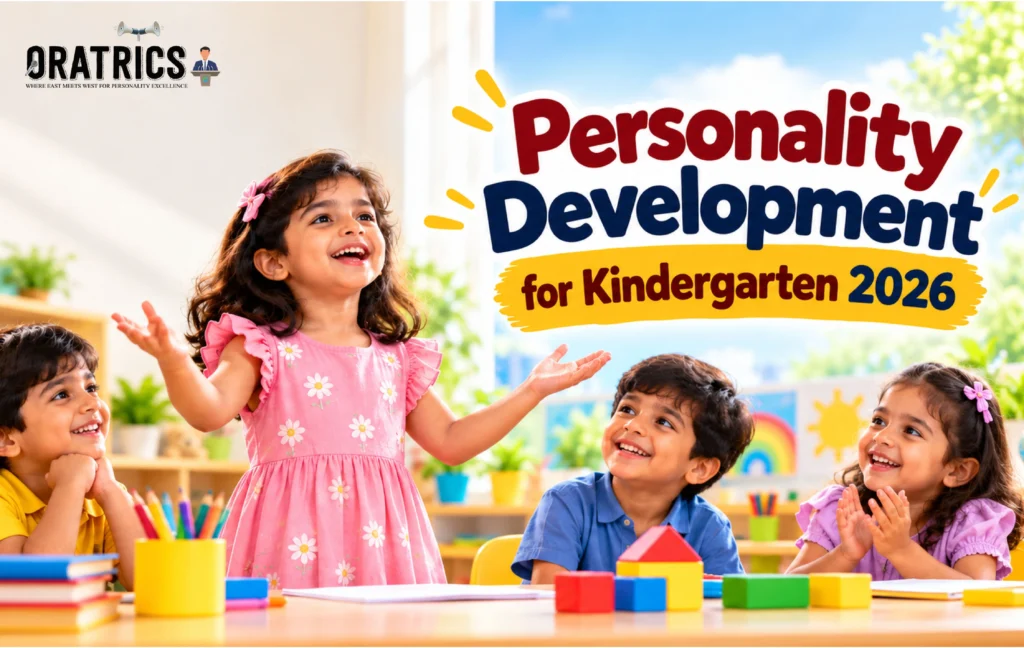
Every parent wants a child who is confident, kind and happy to speak up. That’s why personality development for kindergarten 2026 become more important for the families who want their children to start strong. The good news is that you no longer need to travel to a centre to do it. With the best kindergarten personality development course delivered online, children aged 3 to 6 can build confidence, communication and social skills from the comfort of home. In this guide, you will learn what personality development really means at this age, which skills matter most, how to choose a good program, and how the online personality development course for kids by Oratrics helps young learners grow.
What Is Personality Development for Kindergarten Children?
Personality development at the kindergarten stage is not about making a child “perfect” or louder. It is about helping a young child understand their feelings, express their ideas, get along with others and feel good about who they are.
Between ages 3 and 6, a child’s brain is growing very fast. Habits, attitudes and the way a child sees themselves start forming now. Gentle, play-based guidance during these years can shape how a child behaves in school and in life.
In simple words, personality development for little ones means growing:
- Confidence: believing “I can try this.”
- Communication: saying what they think and feel in clear words.
- Emotional awareness: naming feelings like happy, angry or scared.
- Social skills: sharing, waiting for a turn and making friends.
- Good manners: Learn to say thank you, please and sorry.
- Independence: doing small tasks on their own.
Why Personality Development Matters More in 2026
Children today grow up around screens, fast content and less face-to-face play. Many kindergarteners know how to swipe a tablet but find it hard to talk to a new classmate or speak in front of a group. Teachers and child development experts often point out that early social and emotional learning supports better classroom behavior and learning habits.
Starting early also helps because:
- Young children copy and learn quickly through play and stories.
- Shy children get a safe space to practice before school pressure grows.
- Confident speaking habits built now carry into primary school.
- Parents get simple tools to support the child at home.
Key Skills a Good Kindergarten Personality Program Should Build
Not every class that uses the word “personality” is well designed. A strong program for this age group should cover the following areas.
1. Speaking and Listening
Children practice speaking in short, clear sentences through show-and-tell, rhymes and story retelling.
2. Emotional Intelligence
Through stories, role play and games, kids learn to recognize feelings and handle them calmly, such as taking a deep breath when upset.
3. Social Skills and Teamwork
Activities like group games and partner tasks teach sharing, patience and kindness.
4. Self-Confidence
Small wins matter. When a child is praised for effort, not only results, they feel safe to try again.
5. Creativity and Curiosity
Questions, imagination games and open-ended activities help children think freely and share original ideas.
6. Basic Etiquette and Values
Simple lessons on manners, honesty and respect build a kind and responsible child.
Read More: Mental Math for class 1 Child
Personality Development for Kids Online: Does It Really Work?
Many parents wonder whether personality development for kids online can match an in-person class. When the class is well planned, the answer is often yes, with a few conditions.
Benefits of learning online
- Comfort of home: Shy children often open up faster in a familiar place.
- Saves time: No travel, so classes fit easily around school and naps.
- Parent involvement: You can sit nearby, see progress and repeat activities later.
- Wider choice: You can pick a trained mentor and program, not just what is close by.
- Flexible timing: Many programs offer different batch slots.
What makes online classes effective for little ones
- Short sessions that match a young child’s attention span
- Live, two-way interaction rather than only watching videos
- Games, stories and songs instead of lectures
- Small groups so every child gets a turn to speak
- Regular feedback shared with parents
Online learning works best when the child is actively taking part. Passive screen time does not build personality; interactive, mentor-led sessions do.
How to Choose the Best Kindergarten Personality Development Course
With so many options, use this simple checklist before you enrol your child.
What to Check | Why It Matters | Good Sign |
Age-appropriate design | Little learners need play, not pressure | Activities made for ages 3 to 6 |
Live interaction | Children learn by doing and speaking | Real-time, two-way classes |
Trained mentors | Warm, patient teachers build trust | Mentors experienced with young children |
Class size | Small groups give more speaking time | Limited seats per batch |
Clear learning goals | You should know what your child will gain | Defined skills and progress updates |
Parent feedback | You stay informed and involved | Regular updates or reports |
Trial option | Lets your child feel comfortable first | Demo class before payment |
Also trust your child’s reaction. If they smile, join in and talk about the class afterwards, you are likely on the right track.
Online Personality Development Course for Kids by Oratrics
Oratrics is an ed tech platform focused on helping children grow into confident communicators. The online personality development course for kids by Oratrics is designed to make learning feel like play while building real, lasting skills.
What Your Child Can Expect
- Live, interactive online classes with a guiding mentor
- Activities that build confidence, speaking, listening and expression
- Story-based and game-based learning suited to kindergarten age
- A friendly, safe space where every child is encouraged to participate
- Progress shared with parents so you can support learning at home
Why Oratrics Is a Better Choice Than Many Other Options
When parents compare programs, they often find that many classes are either too general, too video-heavy or too formal for small children. Here is where Oratrics stands out.
Feature | Typical Generic Program | Oratrics |
Focus | Broad topics, not child-specific | Built around child communication and confidence |
Learning style | Pre-recorded videos or lectures | Live, interactive, activity-led sessions |
Age fit | One plan for all ages | Content matched to the child’s age group |
Parent involvement | Little or no updates | Parents kept in the loop on progress |
Child comfort | Can feel stressful or rushed | Playful, encouraging environment |
The real difference is the approach: Oratrics puts the child’s comfort and speaking practice first, so growth happens naturally rather than by force.
Simple Ways Parents Can Support Personality Development at Home
Classes work best when home habits support them. Try these easy ideas:
- Talk daily: Ask open questions like “What made you smile today?”
- Read together: Pause to ask what a character felt and why.
- Praise effort: Say “You tried so hard!” instead of only “Good job.”
- Give small choices: Let your child pick between two outfits or snacks.
- Model good behavior: Children copy what they see, so use polite words yourself.
- Encourage play with others: Playdates build sharing and teamwork.
- Be patient with shyness: Never force or label your child as “shy.”
When Should You Enrol Your Child?
Most children are ready for structured, play-based sessions around age 3 to 4, once they can follow simple instructions and sit with a mentor for a short time. There is no need to wait until school problems appear. If your child avoids talking to others, struggles to express feelings or needs a confidence boost, an online class can be a gentle first step.
Frequently Asked Questions
Children aged 3 to 6 are in a key learning phase, so this is a good time to begin. Choose a program that uses play, stories and short activities rather than formal lessons.
It can be, when classes are live, interactive and led by a trained mentor in small groups. Parent support at home improves results further.
Every child learns at their own pace. Many parents notice small changes, such as more eye contact, clearer speech or willingness to join in, within a few weeks of regular classes. Lasting growth needs steady practice.
Oratrics focuses on live, child-friendly sessions that build confidence and communication through play, with parents kept informed about progress. You can check the current course details and book a demo on the Oratrics website.
Want your child to build these skills with an expert mentor?