Table of contents
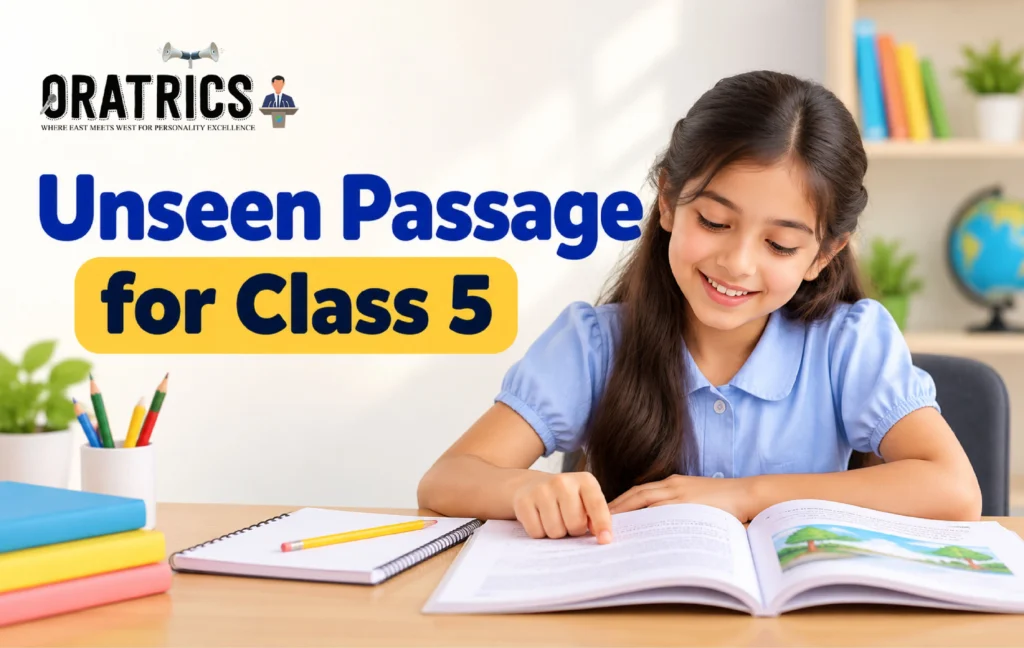
Reading well is one of the most useful skills a child builds in primary school. Regular practice of an unseen passage for class 5 helps students read carefully, understand new ideas and answer questions in their own words. Good comprehension for class 5 also improves vocabulary, grammar and writing, and it makes every other subject easier. This guide gives you original short passages with questions and answers, simple strategies, and a skills table you can use at home or in class.
What Is an Unseen Passage?
An unseen passage is a short piece of text the student has not read before. After reading it, the student answers questions based only on what the passage says.
In an exam, an unseen passage for class 5 in English usually carries 8 to 10 marks. It is among the easiest sections to score full marks in, because every answer is hidden inside the text.
Why Reading Comprehension for Class 5 Matters
Students at this age move from learning to read to reading to learn. Strong reading comprehension for class 5 helps children to:
- Understand textbook chapters in science and social studies
- Build new words without memorising lists
- Improve spelling and sentence formation
- Think clearly and explain ideas
- Feel confident in school exams
The same applies to reading comprehension grade 5 in other school boards. The skill is the same everywhere.
Read more:
Types of Questions in a Comprehension Passage for Class 5
A typical comprehension passage for class 5 has these question types:
Question Type | What It Tests | Example |
Factual (Who, What, When, Where) | Finding details in the text | Who found the lost kitten? |
Vocabulary | Meaning of words in context | Find a word which means “very happy.” |
True or False | Careful reading | The story took place at night. |
Inference (Why, How) | Understanding beyond the lines | Why was Meera worried? |
Title or Theme | Main idea of the passage | Suggest a suitable title. |
Fill in the blanks | Recall and accuracy | The farmer woke up at ______. |
Short Unseen Passage for Class 5 with Answers
Here are three original passages with answers. Each is a short passage for class 5, so students can try them in about ten minutes.
Passage 1: The Little Banyan Tree
Near Riya’s school stood an old banyan tree. Its roots hung down like long brown ropes, and its leaves gave cool shade to everyone. During the break, children played games under it. Birds made their homes among its branches, while squirrels scampered up and down its sturdy trunk.
One summer, a strong storm broke a large branch. Riya felt sad and told her teacher. The next day the whole class is there around the tree. They watered its roots, cleaned the fallen leaves and planted a small sapling beside it. “Every tree needs friends,” said the teacher.
Months later, the sapling grew taller, and the old banyan looked happy again.
Questions
- What did the roots of the banyan tree look like?
- Who lived in the branches of the tree?
- Why did Riya feel sad?
- What did the class do to help the tree?
- Find a word in the passage that means “gathered.”
- Write True or False: The storm happened in winter.
- Suggest a suitable title for the passage.
Answers
- They looked like long brown ropes.
- Birds made their homes among its branches, while squirrels scampered up and down its sturdy trunk.
- A strong storm had broken a large branch of the tree.
- They watered the roots, cleaned the fallen leaves and planted a sapling.
- Gathered (the word “gathered” itself appears; a similar meaning is “assembled”).
- False. It happened in summer.
- “Friends of the Banyan Tree” (any suitable title is accepted).
Passage 2: A Day at the Science Fair
Aman was nervous on the day of the school science fair. He had built a small water filter using sand, pebbles and cotton. His friends laughed at his simple model, but Aman did not give up.
When the judges arrived, he poured muddy water into the top of the filter. Slowly, clear water dripped into the glass below. The judges were delighted by his idea. One of them remarked that even simple solutions could address major challenges. Aman secured second place and realized that self-confidence is just as important as intelligence and creativity.
Questions
- What materials did Aman use for his filter?
- How did Aman feel before the fair?
- What did the judges see when the muddy water was poured?
- Which prize did Aman win?
- What lesson did Aman learn?
- Write the opposite of the word “simple.”
Answers
- Sand, pebbles and cotton.
- He felt nervous.
- Clear water dripped into the glass below.
- Second prize.
- Confidence matters as much as cleverness.
- Complex (or difficult).
Passage 3: The Honey Bee
Honey bees are small insects, but they work very hard. A single hive can hold thousands of bees, and each one has a job. Some bees collect nectar from flowers, some guard the hive, and others take care of the baby bees.
When a bee finds a good patch of flowers, it returns to the hive and does a special “waggle dance.” This dance tells the other bees where to find the flowers. Bees also help the planet because they carry pollen from flower to flower, which helps plants grow fruits and seeds.
Questions
- What do bees collect from flowers?
- Name one job of a bee inside the hive.
- What is the “waggle dance” used for?
- How do bees help plants?
- Pick the correct option: Bees are (a) lazy (b) hardworking (c) noisy.
Answers
- Nectar.
- Guarding the hive or caring for baby bees.
- It tells other bees where to find flowers.
- They carry pollen from flower to flower, which helps plants grow fruits and seeds.
- (b) hardworking.
How to Solve an Unseen Passage for Class 5th Students: Simple Steps
Here is an easy method for unseen passage class 5 students:
- Read the passage twice. First read for the overall idea, then read slowly for details.
- Read the questions before the second reading. You will know what to look for.
- Underline key lines. Mark names, places, numbers and reasons.
- Answer in complete sentences. Start with words from the question.
- Use your own words for “why” and “how” questions, but stay true to the passage.
- Guess word meanings from context. Look at the sentences around the new word.
- Check spelling and punctuation before submitting.
Tips for Parents and Teachers
- Give your child 10 to 15 minutes of passage practice daily.
- Use comprehension worksheets for class 5 that mix stories, facts and short articles.
- Ask your child to retell the passage aloud in two or three lines.
- Encourage reading newspapers for children, storybooks and simple science magazines.
- Praise effort, not only marks.
- Increase difficulty slowly, moving from a short unseen passage for class 5 to longer ones.
Weekly Practice Plan
Day | Activity | Time |
Monday | Read one short passage and answer factual questions | 15 min |
Tuesday | Vocabulary practice from the same passage | 10 min |
Wednesday | Try a new passage with inference questions | 15 min |
Thursday | Comprehension worksheets for class 5 | 20 min |
Friday | Retell and write a title and summary | 15 min |
Weekend | Free reading of a storybook | 20 min |
Common Mistakes to Avoid
- Copying whole lines without understanding them
- Skipping the passage and guessing from questions
- Adding your own opinion where the text gives facts
- Leaving “why” questions incomplete
- Spending too long on one question
Frequently Asked Questions
Most passages are between 100 and 200 words, followed by 5 to 8 questions. Start with shorter ones and increase the length as your child becomes more confident.
Daily reading, discussing what was read, learning new words in context and regular practice with passages all help. Ten to fifteen minutes a day brings visible improvement in a few weeks.
Yes. Full-sentence answers are clearer and usually score better, especially for “why” and “how” questions. One-word answers are fine for fill-in-the-blanks and multiple-choice questions.
Look at school textbooks, children’s newspapers, storybooks and trusted educational websites. You can also write simple passages yourself on topics your child likes and frame questions around them.
Want your child to build these skills with an expert mentor?