Table of contents
- 12 Months Name in English with Correct Spellings
- January to December: All 12 Months in Order
- Months Name in English with Number of Days
- 12 Month Name in English with Spelling and Pronunciation
- Months in English and Their Short Forms
- 12 Month Name in English: Months and Their Seasons
- Easy Tricks to Remember All 12 Months Name in English
- Interesting Facts About the 12 Months of the Year
- Practice Worksheet
- Frequently Asked Questions
A month is a part of the year that helps us keep track of time. We use months to plan school days, holidays, birthdays and festivals. There are 12 months in a year, and learning the month name in English is one of the first calendar skills every child needs. Whether you want the 12 month name list for homework or the 12 month name in English with correct spellings for a test, this guide covers it all. You will learn the order of the months, how many days each has, short forms, seasons, memory tricks, fun facts and a practice worksheet.

12 Months Name in English with Correct Spellings
Here is the complete list of the 12 months, from January to December.
No. | Month Name | Short Form | Number of Days |
1 | January | Jan | 31 |
2 | February | Feb | 28 (29 in a leap year) |
3 | March | Mar | 31 |
4 | April | Apr | 30 |
5 | May | May | 31 |
6 | June | Jun | 30 |
7 | July | Jul | 31 |
8 | August | Aug | 31 |
9 | September | Sep or Sept | 30 |
10 | October | Oct | 31 |
11 | November | Nov | 30 |
12 | December | Dec | 31 |
Remember: every month name starts with a capital letter, even in the middle of a sentence. We write “My birthday is in March,” not “march.”
January to December: All 12 Months in Order
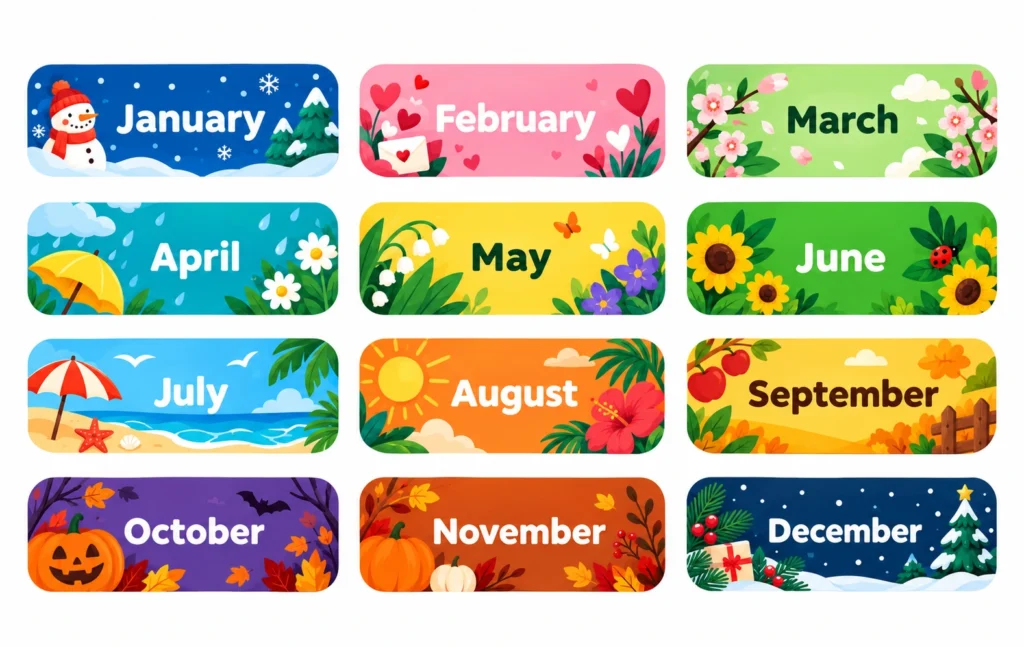
The months always come in the same order, like beads on a string:
- January
- February
- March
- April
- May
- June
- July
- August
- September
- October
- November
- December
After December, the year ends and a new year begins with January again. Think of the year as a circle: when you reach the last month, you simply start over.
Easy way to remember: January is the “door” that opens the year, and December is the “door” that closes it. Everything else walks in between, one month at a time.
Months Name in English with Number of Days
Not all months are the same length. Some have 31 days, some have 30, and one is special.
Days | Months |
31 days | January, March, May, July, August, October, December |
30 days | April, June, September, November |
28 or 29 days | February |
So there are seven months with 31 days, four months with 30 days, and one month, February, with 28 days (29 in a leap year). In a normal year there are 365 days.
What Is a Leap Year?
The Earth takes a little more than 365 days to go around the Sun: about 365 and a quarter days. Those extra quarter days add up, so about every four years we add one extra day, 29 February. A year with 366 days is called a leap year. Years like 2024 and 2028 are leap years. Century years (such as 1900) are leap years only if they can be divided by 400, which is why 2000 was a leap year but 1900 was not.
12 Month Name in English with Spelling and Pronunciation
Say each month aloud, clapping once for each part (syllable).
Month | How to Say It | Syllables |
January | JAN-yoo-air-ee | 4 |
February | FEB-roo-air-ee (or FEB-yoo-air-ee) | 4 |
March | MARCH | 1 |
April | AY-pril | 2 |
May | MAY | 1 |
June | JOON | 1 |
July | joo-LY | 2 |
August | AW-gust | 2 |
September | sep-TEM-ber | 3 |
October | ok-TOH-ber | 3 |
November | noh-VEM-ber | 3 |
December | dee-SEM-ber | 3 |
Common Spelling Mistakes
- February: Many children forget the first “r” and write “Febuary.” Say it slowly: Feb-ru-ary.
- January: Remember the “u” in the middle: Jan-u-ary.
- August: It ends in “-ust,” not “-ist.”
- September to December: These four end in “-ber.” Write the “b” carefully.
- Capital letters: Always start with a capital: June, not june.
Months in English and Their Short Forms
On calendars, forms and timetables, space is small, so we use short forms (abbreviations), usually the first three letters.
Full Month | Short Form |
January | Jan |
February | Feb |
March | Mar |
April | Apr |
May | May |
June | Jun |
July | Jul |
August | Aug |
September | Sep / Sept |
October | Oct |
November | Nov |
December | Dec |
Examples of use:
- On a calendar: “Aug 15” means 15 August.
- In a date: “12 Oct 2026” means 12 October 2026.
- In numbers: 05/03 can mean 5 March or 3 May depending on the country, so write the month name to avoid confusion.
May, June and July are short already, so some people write them in full. Both are fine.
12 Month Name in English: Months and Their Seasons
Seasons depend on where you live. When it is summer in the northern half of the world (the Northern Hemisphere), it is winter in the southern half (the Southern Hemisphere). So the same month can have different weather in different countries.
In most of India, people often talk about these seasons. They are general guides, and weather differs between regions such as Kerala, Rajasthan and Kashmir.
Season | Usual Months in India |
Winter | December, January, February |
Summer | March, April, May |
Monsoon (rainy season) | June, July, August, September |
Autumn / post-monsoon | October, November |
In many parts of India, it is hot in May and rainy in July. But in Australia, July is a cool winter month. Ask your teacher what the weather is like in your own city in each month.
Easy Tricks to Remember All 12 Months Name in English
- Learn in groups of three. Four small groups are easier than twelve names: January, February, March. April, May, June. July, August, September. October, November, December.
- Use a calendar. Hang a calendar at home. Each morning, point to the month and say its name.
- Sing or chant. Set the months to a tune you know, like a nursery rhyme. Music helps memory.
- Make flashcards. Write the month on one side and a drawing on the other: a kite for August, a pumpkin for October, a snowman for December.
- Play memory games. Mix the cards up and race a friend to put them back in order.
- Repeat daily. Two minutes a day is better than one long lesson a week.
- Try the knuckle trick. Make a fist and look at the bumps (knuckles) and the dips between them. Start on the first knuckle of your index finger and say “January.” Move to the dip for “February,” the next knuckle for “March,” and so on. Every month that lands on a knuckle has 31 days. Every month that lands in a dip has 30 days (except February). When you reach the last knuckle (July), jump back to the first knuckle again for August and carry on to December.
Interesting Facts About the 12 Months of the Year
- January is named after Janus, the Roman god of doors and new beginnings.
- July and August are named after two Roman rulers, Julius Caesar and Augustus.
- The names September, October, November and December come from old Latin numbers for 7, 8, 9 and 10. In the old Roman calendar, the year started in March, so they really were the seventh to tenth months.
- February is the shortest month, with only 28 or 29 days.
- A person born on 29 February is called a “leapling” and has a birthday only once every four years.
- The word “month” is linked to the word “moon,” because early calendars followed the Moon’s cycle of about 29 and a half days.
- There are 52 weeks and one extra day (two in a leap year) in a normal year.
- May is the only month that has the same full name and short form.
Practice Worksheet
- Write the first month of the year: ________
- Write the last month of the year: ________
- Fill in the missing months: June, ________, August, September
- Write the short form of November: ________
- How many days does April have? ________
- Which month comes after October? ________
- Name the month with 28 or 29 days: ________
- Correct the spelling: Febuary → ________
- Circle the 31-day months: April, July, September, December
- How many months are in a year? ________
Answers: 1. January; 2. December; 3. July; 4. Nov; 5. 30 days; 6. November; 7. February; 8. February; 9. July and December; 10. 12
Frequently Asked Questions
The 12 months are January, February, March, April, May, June, July, August, September, October, November and December, in that order.
January is the first month of the year in the Gregorian calendar, which is used in India and most countries for everyday dates and schools.
December is the last month of the year. After 31 December, a new year starts on 1 January.
There are 12 months in a year. Together they add up to 365 days in a normal year and 366 days in a leap year.
February. It has 28 days in a normal year and 29 days in a leap year, which comes about every four years.
April, June, September and November have 30 days each. A rhyme many children learn is “Thirty days hath September, April, June and November.”
January, March, May, July, August, October and December have 31 days. That makes seven months with 31 days.
Learn them in groups of three, sing them as a song, use a wall calendar, play flashcard games and repeat them for a few minutes every day.
Jan, Feb, Mar, Apr, May, Jun, Jul, Aug, Sep (or Sept), Oct, Nov and Dec. May is usually written in full.
The Earth takes about 365 and a quarter days to circle the Sun. We add one extra day to February about every four years to keep the calendar matched to the seasons.
Want your child to build these skills with an expert mentor?