Table of contents
- What Are Action Words?
- Why Should Kids Learn Action Words?
- How to Teach Action Words to Kids
- 100 Action Words in English With Meanings & Examples
- 1. Run
- 2. Walk
- 3. Jump
- 4. Hop
- 5. Skip
- 6. Dance
- 7. Sing
- 8. Clap
- 9. Wave
- 10. Smile
- 11. Laugh
- 12. Cry
- 13. Read
- 14. Write
- 15. Draw
- 16. Paint
- 17. Color
- 18. Cut
- 19. Paste
- 20. Build
- 21. Throw
- 22. Catch
- 23. Kick
- 24. Push
- 25. Pull
- 26. Lift
- 27. Carry
- 28. Hold
- 29. Drop
- 30. Catch
- 31. Eat
- 32. Drink
- 33. Cook
- 34. Bake
- 35. Wash
- Quick Activity: Can You Use These Words?
- Why Repetition Matters
- 100 Action Words in English for Kids Part 2
- Action Words 36-70 With Meanings & Examples
- 36. Clean
- 37. Brush
- 38. Comb
- 39. Wear
- 40. Dress
- 41. Sleep
- 42. Wake
- 43. Sit
- 44. Stand
- 45. Lie
- 46. Crawl
- 47. Swim
- 48. Dive
- 49. Climb
- 50. Slide
- 51. Open
- 52. Close
- 53. Turn
- 54. Shake
- 55. Touch
- 56. Point
- 57. Look
- 58. Watch
- 59. See
- 60. Listen
- 61. Hear
- 62. Speak
- 63. Talk
- 64. Ask
- 65. Answer
- 66. Tell
- 67. Explain
- 68. Think
- 69. Learn
- 70. Teach
- Grouping Action Words Makes Learning Easier
- Movement Action Words
- Daily Routine Action Words
- Classroom Action Words
- Creative Action Words
- Fun Games to Practice Action Words
- 1. Action Charades
- 2. Simon Says
- 3. Story Building
- 4. Picture Guessing
- Tips for Parents and Teachers
- Keep Building Vocabulary Every Day
- 100 Action Words in English for Kids Part 3
- Action Words 71-100 With Meanings & Examples
- 71. Help
- 72. Share
- 73. Give
- 74. Take
- 75. Find
- 76. Lose
- 77. Keep
- 78. Hide
- 79. Show
- 80. Choose
- 81. Play
- 82. Practice
- 83. Study
- 84. Count
- 85. Measure
- 86. Grow
- 87. Plant
- 88. Water
- 89. Create
- 90. Imagine
- 91. Dream
- 92. Remember
- 93. Forget
- 94. Celebrate
- 95. Hug
- 96. Kiss
- 97. Love
- 98. Care
- 99. Protect
- 100. Explore
- How to Make Learning Action Words Fun
- Common Mistakes Kids Make with Action Words
- Why Learning Action Words Matters
- Quick Revision Activity
- Conclusion
- Frequently Asked Questions
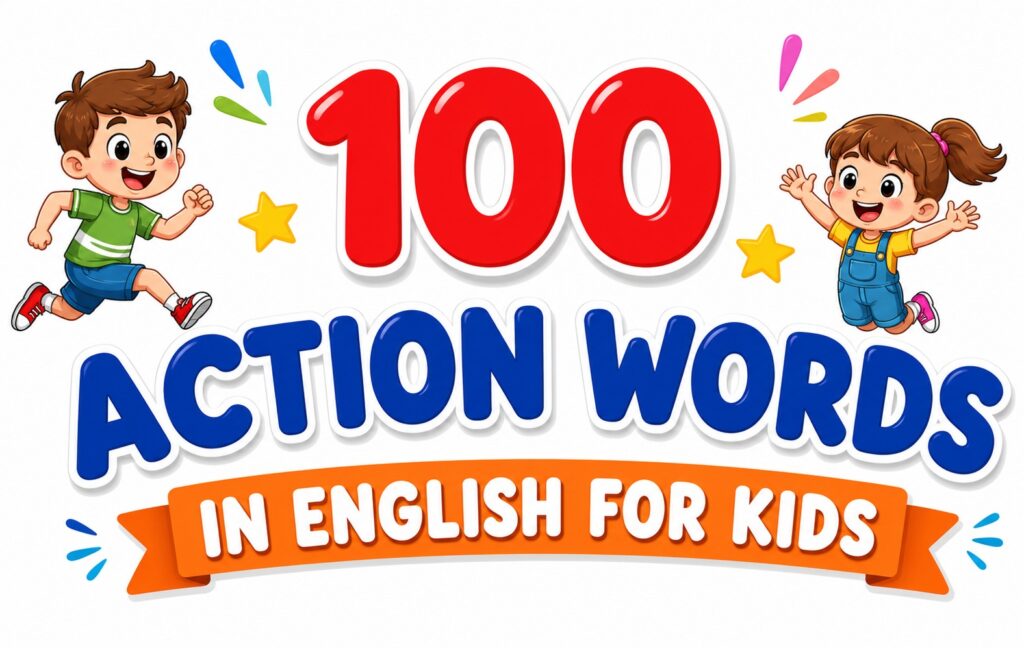
Learning English is an exciting journey, especially for children. Every new word they learn helps them express themselves better and understand the world around them. Among all the words in the English language, action words are some of the most important because they describe what people, animals, and even things do every day. That’s why we’ve put together this list of 100 action words in English to help your child build a strong foundation.
Think about a child’s daily routine. They wake up, brush their teeth, eat breakfast, walk to school, play with friends, read books, and sleep at night. Every one of these activities is described using an action word. Without action words, it would be almost impossible to communicate clearly.
Whether your child is learning to speak, beginning to read, or improving their writing skills, building a strong vocabulary of action words can make a huge difference. These words help children create complete sentences, tell interesting stories, answer questions confidently, and communicate their thoughts with ease.
If you’re a parent looking for ways to teach English at home or a teacher searching for classroom resources, this guide is designed to make learning simple and enjoyable. Instead of memorizing long vocabulary lists, children can learn action words through easy meanings, relatable examples, and everyday situations.
In this article, you’ll discover 100 action words in English that every child should know, along with simple meanings and easy example sentences. You’ll also find practical teaching tips, fun learning activities, and answers to common questions that make vocabulary building both effective and enjoyable.
What Are Action Words?
Action words are words that tell us what someone or something is doing. In grammar, action words are called verbs. Every sentence needs a verb because it shows the action taking place.
For example:
- The girl runs in the park.
- Dad cooks
- The bird flies across the sky.
- We read books every evening.
The highlighted words, runs, cooks, flies, and read, are all action words because they describe an activity.
Imagine trying to speak without action words. Instead of saying, “I play football,” you’d only say, “I football,” which doesn’t make sense. Action words bring sentences to life by telling us exactly what’s happening.
Children naturally learn many action words through observation. They hear parents say things like “Come here,” “Sit down,” “Wash your hands,” or “Eat your lunch.” Over time, they connect these words with the actions they perform, making them an important part of language development.
Why Should Kids Learn Action Words?
Action words are much more than vocabulary words. They are the building blocks of communication. The more action words children know, the easier it becomes for them to express ideas, understand stories, and participate in conversations.
Here are some of the biggest benefits of learning action words:
1. They Improve Speaking Skills
Children who know a variety of action words can explain what they’re doing more clearly. Instead of saying “I did something,” they can say “I painted a picture,” “I climbed a tree,” or “I helped my friend.”
2. They Build Strong Writing Skills
Good writing depends on strong verbs. Action words make stories interesting and descriptive. Compare these two sentences:
- The dog was there.
- The dog chased the ball across the garden.
The second sentence creates a much clearer picture because it includes an action word.
3. They Support Reading Development
As children begin reading books, they’ll come across many action words. Knowing these words helps them understand stories more quickly and confidently.
4. They Encourage Better Communication
Children use action words every day while talking to parents, teachers, classmates, and friends. A strong vocabulary helps them communicate their needs, emotions, and ideas more effectively.
5. They Make Learning Fun
Many action words can be taught through movement and games. Activities like charades, Simon Says, storytelling, and role-playing help children remember words naturally while having fun.
How to Teach Action Words to Kids
Children learn best when lessons feel like play rather than study. Here are a few simple ways to introduce action words.
Use Daily Activities
Point out actions throughout the day.
- “You’re brushing your teeth.”
- “Let’s wash our hands.”
- “Can you jump?”
- “Let’s carry the groceries.”
This helps children connect words with real-life actions.
Read Storybooks Together
Storybooks are filled with action words. Pause while reading and ask questions like:
- What is the rabbit doing?
- Can you show me how the boy is running?
- What happens next?
Play Action Games
Games like Simon Says or Action Charades are excellent for learning new verbs while staying active.
Encourage Storytelling
Ask children to describe what they did during the day using action words.
For example:
“I woke up early, brushed my teeth, ate breakfast, walked to school, played football, and studied English.”
This naturally reinforces vocabulary.
100 Action Words in English With Meanings & Examples
Let’s begin with the first 35 action words.
1. Run
Meaning: To move quickly using your legs.
Example: Rahul runs every morning before school.
2. Walk
Meaning: To move at a normal pace on your feet.
Example: We walk to the park every Sunday evening.
3. Jump
Meaning: To push yourself into the air using your legs.
Example: The little girl jumps over the puddle.
4. Hop
Meaning: To jump on one foot or make small jumps.
Example: The rabbit hops across the garden.
5. Skip
Meaning: To move forward by hopping lightly.
Example: The children skip happily toward the playground.
6. Dance
Meaning: To move your body to music.
Example: Everyone dances during the school celebration.
7. Sing
Meaning: To produce musical sounds with your voice.
Example: The students sing the national anthem every morning.
8. Clap
Meaning: To strike your hands together.
Example: We clap after every performance.
9. Wave
Meaning: To move your hand as a greeting.
Example: She waves goodbye to her grandparents.
10. Smile
Meaning: To show happiness with your face.
Example: The baby smiles when she sees her mother.
11. Laugh
Meaning: To make happy sounds when something is funny.
Example: We laugh while watching funny cartoons.
12. Cry
Meaning: To shed tears because of sadness or pain.
Example: The child cries after falling from the bicycle.
13. Read
Meaning: To look at words and understand them.
Example: I read a new story every night.
14. Write
Meaning: To form letters and words on paper or a screen.
Example: She writes neatly in her notebook.
15. Draw
Meaning: To make a picture using a pencil or pen.
Example: Aarav draws beautiful animals.
16. Paint
Meaning: To create pictures using paint.
Example: The children paint colorful butterflies.
17. Color
Meaning: To fill a picture using crayons or pencils.
Example: My sister colors the rainbow with bright crayons.
18. Cut
Meaning: To divide something using scissors or a knife.
Example: Please cut the paper carefully.
19. Paste
Meaning: To stick something using glue.
Example: The students paste pictures into their scrapbooks.
20. Build
Meaning: To make or construct something.
Example: We build a sandcastle at the beach.
21. Throw
Meaning: To send something through the air.
Example: The boy throws the ball to his friend.
22. Catch
Meaning: To stop and hold something moving.
Example: She catches the ball with both hands.
23. Kick
Meaning: To hit something using your foot.
Example: The football player kicks the ball into the goal.
24. Push
Meaning: To move something away from you.
Example: Push the door gently before entering.
25. Pull
Meaning: To move something toward yourself.
Example: Pull the chair closer to the table.
26. Lift
Meaning: To raise something upward.
Example: He lifts the heavy box carefully.
27. Carry
Meaning: To hold and move something from one place to another.
Example: Please carry your school bag properly.
28. Hold
Meaning: To keep something in your hands.
Example: Hold my hand while crossing the road.
29. Drop
Meaning: To let something fall accidentally.
Example: Don’t drop your water bottle.
30. Catch
Meaning: To take hold of something before it falls.
Example: Can you catch the balloon?
31. Eat
Meaning: To put food into your mouth and chew it.
Example: We eat fresh fruits every day.
32. Drink
Meaning: To swallow water or any other liquid.
Example: Drink enough water during summer.
33. Cook
Meaning: To prepare food.
Example: My grandmother cooks delicious meals.
34. Bake
Meaning: To cook food in an oven.
Example: We bake cupcakes on weekends.
35. Wash
Meaning: To clean something with water.
Example: Always wash your hands before eating.
Quick Activity: Can You Use These Words?
Try asking your child these questions:
- Can you run like a cheetah?
- Can you hop like a bunny?
- Can you clap five times?
- Can you wave to your friend?
- Can you draw your favorite animal?
- Can you carry your backpack?
- Can you smile for a photo?
Turning vocabulary into action helps children remember words much faster than simply reading them from a list.
Why Repetition Matters
Children don’t learn new words overnight. The secret to building vocabulary is repetition. The more often children hear, see, and use action words, the more naturally they become part of their everyday language.
A good way to reinforce learning is by introducing just five to ten new action words each week. Encourage children to use those words in conversations, write them in simple sentences, and act them out during playtime. Over time, they’ll begin using these words confidently without even thinking about it.
In the next section, we’ll continue with action words 36 to 70, covering everyday activities, communication, learning, and creative expressions that children use in school and at home.
100 Action Words in English for Kids Part 2
By now, we’ve explored the first 35 action words and learned how they help children communicate more effectively. As your child’s vocabulary grows, they’ll begin using more descriptive verbs in everyday conversations. Instead of saying “I did something,” they’ll be able to explain exactly what they did, whether they cleaned their room, climbed a tree, or explained a lesson to a friend.
The best part about learning action words is that children use them every single day without even realizing it. From getting ready in the morning to playing with friends, attending school, helping at home, and enjoying hobbies, almost every activity involves an action word.
Let’s continue with the next set of words.
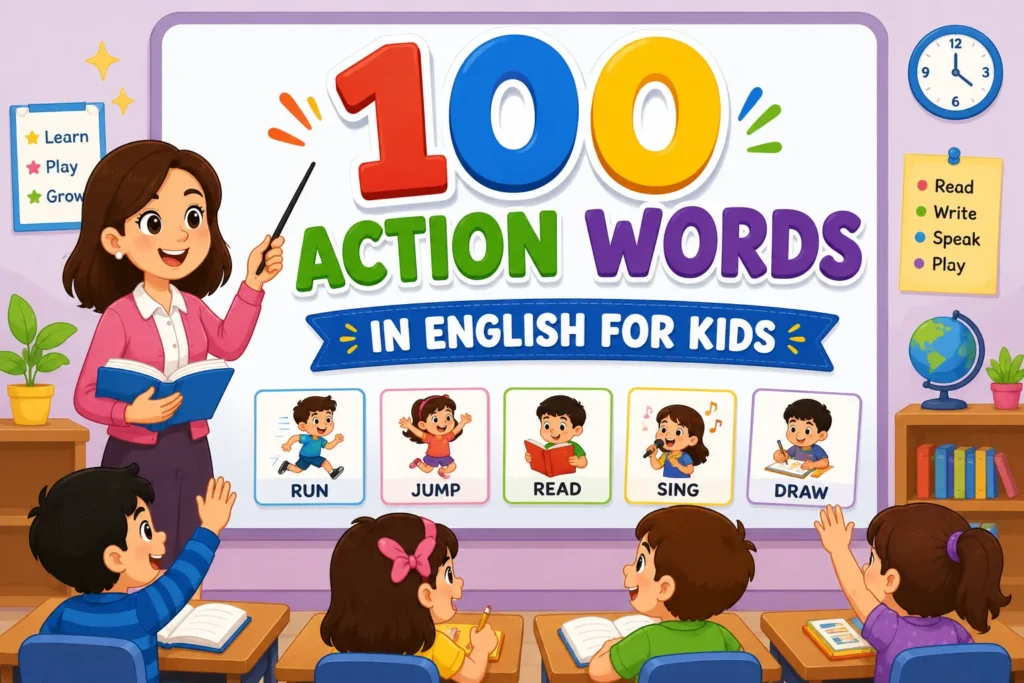
Action Words 36-70 With Meanings & Examples
36. Clean
Meaning: To remove dirt and make something tidy.
Example: Every Saturday, Riya cleans her study table before doing her homework.
37. Brush
Meaning: To clean or smooth something using a brush.
Example: We brush our teeth every morning and night.
38. Comb
Meaning: To arrange your hair with a comb.
Example: Aarav combs his hair before leaving for school.
39. Wear
Meaning: To have clothes or accessories on your body.
Example: We wear our school uniforms from Monday to Friday.
40. Dress
Meaning: To put on clothes.
Example: My little brother can dress himself without any help.
41. Sleep
Meaning: To rest with your eyes closed.
Example: Children need enough sleep to stay healthy and active.
42. Wake
Meaning: To stop sleeping.
Example: I wake up at 6:30 every morning.
43. Sit
Meaning: To rest on a chair or the ground.
Example: Please sit quietly while the teacher explains the lesson.
44. Stand
Meaning: To be on your feet.
Example: The students stand when the principal enters the classroom.
45. Lie
Meaning: To rest in a flat position.
Example: The puppy lies on the soft blanket.
46. Crawl
Meaning: To move on your hands and knees.
Example: Babies usually crawl before they learn to walk.
47. Swim
Meaning: To move through water.
Example: Fish swim effortlessly in the river.
48. Dive
Meaning: To jump into water.
Example: The lifeguard dives into the pool to rescue the child.
49. Climb
Meaning: To move upward using your hands and feet.
Example: Monkeys climb trees with great speed.
50. Slide
Meaning: To move smoothly across a surface.
Example: The children slide down the playground slide again and again.
51. Open
Meaning: To move something so it is no longer closed.
Example: Please open your English book to page twenty.
52. Close
Meaning: To shut something.
Example: Close the window because it’s starting to rain.
53. Turn
Meaning: To move in another direction.
Example: Turn left at the traffic signal.
54. Shake
Meaning: To move something quickly from side to side.
Example: Shake the juice bottle before drinking it.
55. Touch
Meaning: To place your hand or finger on something.
Example: Don’t touch the hot pan.
56. Point
Meaning: To show something with your finger.
Example: Can you point to the elephant in the picture?
57. Look
Meaning: To direct your eyes toward something.
Example: Look at the beautiful rainbow in the sky.
58. Watch
Meaning: To look at something carefully for some time.
Example: We watch educational videos after school.
59. See
Meaning: To notice something with your eyes.
Example: I can see birds flying over the lake.
60. Listen
Meaning: To pay attention to sounds.
Example: Always listen carefully to your teacher.
61. Hear
Meaning: To notice sounds through your ears.
Example: I can hear the rain falling outside.
62. Speak
Meaning: To say words aloud.
Example: She speaks English confidently in class.
63. Talk
Meaning: To have a conversation.
Example: Best friends love to talk during lunch break.
64. Ask
Meaning: To request information or help.
Example: Don’t be afraid to ask questions if you don’t understand something.
65. Answer
Meaning: To reply to a question.
Example: The students answered every question correctly.
66. Tell
Meaning: To give information or share something.
Example: Grandpa tells wonderful bedtime stories.
67. Explain
Meaning: To make something easier to understand.
Example: The teacher explains difficult ideas using simple examples.
68. Think
Meaning: To use your mind.
Example: Think carefully before choosing your answer.
69. Learn
Meaning: To gain new knowledge or skills.
Example: Every day we learn something new at school.
70. Teach
Meaning: To help someone learn.
Example: Good teachers teach with patience and kindness.
Grouping Action Words Makes Learning Easier
Children often remember words better when they are connected to a theme instead of learning random vocabulary. Here are some simple categories you can use while teaching.
Movement Action Words
These words describe physical movement.
- Run
- Walk
- Jump
- Skip
- Hop
- Crawl
- Swim
- Climb
- Dive
- Slide
You can practice these words outdoors by asking children to perform each action.
Daily Routine Action Words
These words are part of everyday life.
- Wake
- Brush
- Wash
- Eat
- Drink
- Dress
- Wear
- Sleep
- Clean
- Cook
Using these words during your child’s morning and bedtime routine helps reinforce learning naturally.
Classroom Action Words
These are common words children hear at school.
- Read
- Write
- Listen
- Speak
- Learn
- Teach
- Ask
- Answer
- Explain
- Think
Teachers can encourage students to use these words in complete sentences throughout the day.
Creative Action Words
These words inspire imagination and creativity.
- Draw
- Paint
- Build
- Color
- Create
- Imagine
- Design
- Decorate
Creative activities allow children to connect language with self-expression.
Fun Games to Practice Action Words
Learning becomes much easier when children are having fun. Here are a few activities you can try at home or in the classroom.
1. Action Charades
Write different action words on small pieces of paper. One child picks a word and acts it out while everyone else guesses the action.
Some great words for this game include:
- Dance
- Jump
- Swim
- Laugh
- Crawl
- Climb
- Read
- Write
This activity improves vocabulary, observation skills, and confidence.
2. Simon Says
One person gives instructions beginning with “Simon says…”
For example:
- Simon says clap your hands.
- Simon says jump three times.
- Simon says touch your nose.
- Simon says sit down.
Children learn action words while following instructions and staying active.
3. Story Building
Ask children to create a short story using at least ten action words.
For example:
“One morning, Maya woke up early. She brushed her teeth, ate breakfast, walked to school, learned new words, played with her friends, laughed during recess, and returned home to read her favorite book.”
This simple exercise improves both vocabulary and storytelling skills.
4. Picture Guessing
Show children a picture and ask questions like:
- What is the boy doing?
- What is the dog doing?
- Can you name three action words in this picture?
Visual learning helps children remember words much faster.
Tips for Parents and Teachers
Helping children learn action words doesn’t require expensive resources or long lessons. Small moments throughout the day can become valuable learning opportunities.
Here are a few practical ideas:
- Introduce five new action words each week instead of overwhelming children with long lists.
- Use the words naturally during conversations at home.
- Encourage children to make their own sentences.
- Read books together and point out action words as you go.
- Praise children whenever they correctly use a new word.
- Repeat familiar words regularly so they stay fresh in memory.
- Turn learning into a game whenever possible.
Remember, consistency matters more than speed. A child who enjoys learning is more likely to remember new vocabulary for years to come.
Keep Building Vocabulary Every Day
By this point, your child has already learned 70 action words in English. That’s a fantastic achievement! More importantly, they’re learning how to use these words in real conversations instead of simply memorizing definitions.
Language develops through practice. The more children read, speak, write, and play with new words, the more confident they become.
In the final part of this guide, we’ll complete the list with action words 71-100, explore even more engaging learning activities, answer frequently asked questions, and wrap up with a practical conclusion that will help children continue expanding their English vocabulary.
100 Action Words in English for Kids Part 3
By now, we’ve covered 70 action words that children commonly use in their daily lives. From running and jumping to reading and learning, these words help kids communicate their ideas clearly and confidently.
In this final section, we’ll complete the list of 100 action words in English, explore more fun ways to practice them, discuss common mistakes children make, and answer some frequently asked questions.
Let’s finish our list!
Action Words 71-100 With Meanings & Examples
71. Help
Meaning: To make someone’s work easier.
Example: I help my mother set the dinner table.
72. Share
Meaning: To give part of something to someone else.
Example: Good friends share their toys.
73. Give
Meaning: To hand something to another person.
Example: Please give me the blue pencil.
74. Take
Meaning: To receive or carry something.
Example: Take your water bottle to school every day.
75. Find
Meaning: To discover something.
Example: Can you find the missing puzzle piece?
76. Lose
Meaning: To be unable to find something.
Example: Don’t lose your library book.
77. Keep
Meaning: To continue having or holding something.
Example: Keep your classroom neat and tidy.
78. Hide
Meaning: To put something where it cannot easily be seen.
Example: The kitten hides behind the sofa.
79. Show
Meaning: To let someone see something.
Example: Show your drawing to the class.
80. Choose
Meaning: To select one option from many.
Example: Choose your favorite storybook.
81. Play
Meaning: To enjoy games or activities.
Example: The children play football after school.
82. Practice
Meaning: To do something regularly to improve.
Example: Practice reading aloud every evening.
83. Study
Meaning: To spend time learning.
Example: I study English for one hour every day.
84. Count
Meaning: To say numbers in order.
Example: Let’s count from one to one hundred.
85. Measure
Meaning: To find the size, length, or amount of something.
Example: Measure the table using a ruler.
86. Grow
Meaning: To become bigger or taller.
Example: Plants grow faster with sunlight and water.
87. Plant
Meaning: To place seeds or young plants into the soil.
Example: We plant flowers in the school garden.
88. Water
Meaning: To pour water on plants.
Example: Don’t forget to water the plants every morning.
89. Create
Meaning: To make something new.
Example: The students create beautiful greeting cards.
90. Imagine
Meaning: To form pictures or ideas in your mind.
Example: Imagine flying like a superhero.
91. Dream
Meaning: To imagine something wonderful or experience thoughts while sleeping.
Example: She dreams of becoming a doctor one day.
92. Remember
Meaning: To keep something in your memory.
Example: Remember to finish your homework.
93. Forget
Meaning: To fail to remember something.
Example: I forgot my lunchbox at home yesterday.
94. Celebrate
Meaning: To enjoy a special event.
Example: We celebrate Children’s Day at school.
95. Hug
Meaning: To hold someone closely to show love or care.
Example: The little girl hugged her grandmother after school.
96. Kiss
Meaning: To touch someone gently with your lips as a sign of affection.
Example: Mom kisses her baby goodnight.
97. Love
Meaning: To care deeply for someone or something.
Example: We love spending time with our family.
98. Care
Meaning: To look after someone or something.
Example: We should care for animals and nature.
99. Protect
Meaning: To keep someone or something safe.
Example: Helmets protect our heads while riding a bicycle.
100. Explore
Meaning: To travel around or learn about something new.
Example: Children love to explore parks, museums, and nature trails.
How to Make Learning Action Words Fun
Children remember vocabulary much better when they enjoy the learning process. Instead of asking them to memorize long lists, try activities that encourage movement, creativity, and conversation.
Play “Guess the Action”
Write different action words on small pieces of paper. One child picks a word and acts it out without speaking, while the others guess the correct action.
This game improves vocabulary while building confidence and observation skills.
Create an Action Diary
Encourage your child to write five action words they used each day.
For example:
- Woke up
- Brushed
- Studied
- Played
- Helped
Over time, children begin recognizing how frequently they use action words in everyday life.
Read Together
Storybooks naturally contain many verbs. While reading, pause occasionally and ask questions like:
- What is the boy doing?
- Which action word describes the dog?
- Can you think of another word that means the same thing?
This helps children notice action words in context rather than learning them in isolation.
Use Flashcards
Create flashcards with a picture on one side and the action word on the other.
For example:
Child running to Run
Girl painting to Paint
Boy reading to Read
Visual learning is especially effective for younger children.
Make Learning Part of Everyday Conversations
Simple conversations are one of the best ways to reinforce vocabulary.
Instead of asking:
“What did you do today?”
Try asking:
- What games did you play?
- What new thing did you learn?
- Who did you help today?
- What did you create in art class?
These questions encourage children to use action words naturally.
Common Mistakes Kids Make with Action Words
Learning verbs takes practice, and it’s completely normal for children to make mistakes along the way.
Here are a few common errors and how to correct them.
Mistake 1: Missing the Action Word
Incorrect: The cat on the chair.
Correct: The cat sleeps on the chair.
Mistake 2: Using the Wrong Verb Form
Incorrect: She go to school every day.
Correct: She goes to school every day.
Mistake 3: Choosing the Wrong Action Word
Incorrect: I drink an apple.
Correct: I eat an apple.
Mistake 4: Forgetting Helping Verbs
Incorrect: He reading a book.
Correct: He is reading a book.
Correcting these mistakes gently helps children build confidence while improving their grammar.
Why Learning Action Words Matters
Action words are more than just grammar. They help children express themselves, describe experiences, and understand the world around them.
A child with a rich vocabulary can:
- Speak confidently during conversations.
- Write more interesting stories.
- Understand books more easily.
- Participate actively in classroom discussions.
- Follow instructions with greater accuracy.
- Express emotions and ideas clearly.
- Build stronger communication skills.
As children continue learning new words, they’ll also improve their reading, writing, listening, and speaking abilities.
Quick Revision Activity
Action words are more than just grammar. They help children express themselves, describe experiences, and understand the world around them.
A child with a rich vocabulary can:
- Speak confidently during conversations.
- Write more interesting stories.
- Understand books more easily.
- Participate actively in classroom discussions.
- Follow instructions with greater accuracy.
- Express emotions and ideas clearly.
- Build stronger communication skills.
As children continue learning new words, they’ll also improve their reading, writing, listening, and speaking abilities.
Conclusion
Learning action words is one of the first and most important steps in a child’s English language journey. These words help children explain what they’re doing, describe their experiences, and communicate confidently with the people around them.
The 100 action words in English shared in this guide cover many of the activities children experience every day, from waking up in the morning and getting ready for school to playing with friends, studying, helping at home, and exploring the world around them.
Remember, children don’t learn vocabulary by memorizing lists alone. They learn best when they hear words in conversations, read them in books, use them while speaking, and practice them through games and everyday activities. A little practice each day goes a long way.
Whether you’re a parent teaching your child at home or a teacher helping students in the classroom, focus on making learning enjoyable. Celebrate small achievements, encourage curiosity, and let children experiment with new words without fear of making mistakes.
Over time, these action words will become a natural part of their vocabulary, helping them become stronger speakers, readers, and writers. Most importantly, they’ll gain the confidence to express themselves clearly, an essential skill that will benefit them both inside and outside the classroom.
Frequently Asked Questions
Action words, also called verbs, describe what a person, animal, or thing does. Words like run, eat, play, and write are all action words.
Action words help children communicate clearly, build their vocabulary, improve sentence formation, and become more confident readers and writers.
Children usually begin learning simple action words between the ages of two and four through daily conversations, songs, stories, and play. As they grow older, they naturally learn more advanced verbs.
Parents can make learning fun by reading storybooks, playing action games, using flashcards, encouraging storytelling, and talking about everyday activities. The key is to use action words regularly in natural conversations.
There’s no fixed number, but learning 100 action words in English provides a strong foundation for everyday communication. Once children are comfortable with these common verbs, they can gradually expand their vocabulary through reading and speaking.
Want your child to build these skills with an expert mentor?