Table of contents
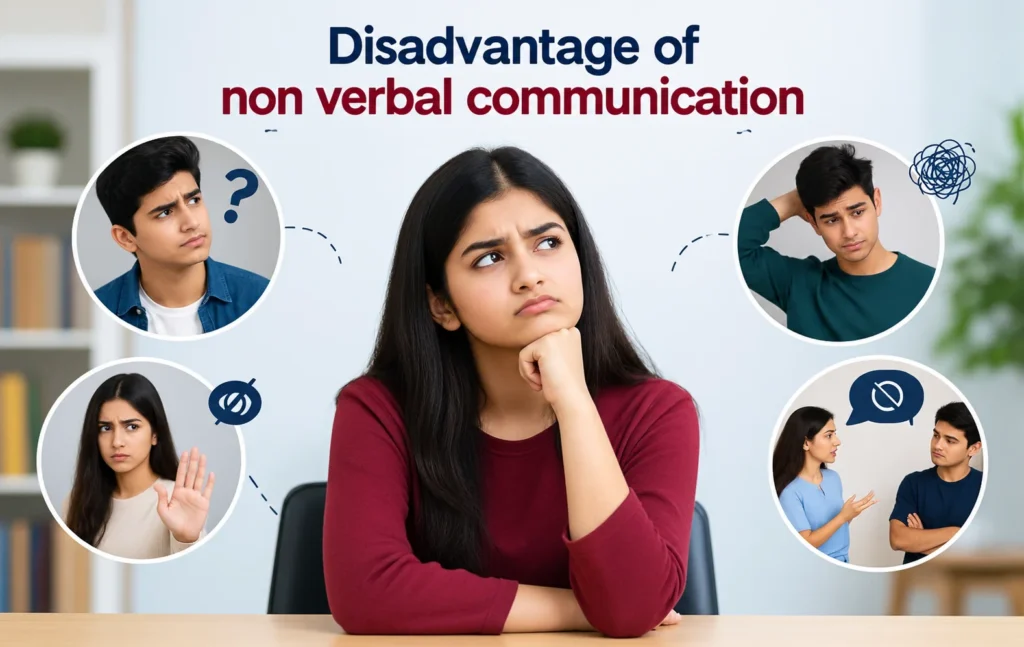
For a long time I assumed body language was the one part of communication people couldn’t fake the honest layer underneath all the careful word choices. Running workshops and sitting through more workplace mediations than I’d like to admit taught me I had that backwards. Somebody crosses their arms and gets read as hostile, when really they’re just cold. Somebody’s voice goes flat and people assume disinterest, when actually they’re exhausted. We treat gestures like they’re effortless and obvious, a nod means yes, a raised eyebrow means surprise, and we hand them all this authority to speak for us. Most of the time they don’t do the job we think they’re doing, and that’s the biggest disadvantage of non verbal communication.
Words at least come with some rules attached. Grammar, agreed-upon definitions, a dictionary you can actually check. Try that with a shrug. Ask five people what it means and you’ll get five answers, all reasonable, all different. That gap, between what feels obvious in the moment and what’s actually landed with the other person, is where a huge amount of miscommunication quietly starts.
I’ve pulled together twelve examples of the disadvantage of non verbal communication that I keep running into, in interviews, negotiations, Zoom calls, classrooms, wherever people are trying to read each other without saying much. I’ll drop in a few of the formal terms along the way too, kinesics, proxemics, haptics, paralanguage, mostly so you’ve got names for what’s happening when a gesture goes sideways.
What Non-Verbal Communication Actually Covers
Take away the spoken and written words and you’re left with everything else: facial expressions, posture, how someone stands, eye contact, tone of voice, touch, the physical distance people keep, even the gaps between sentences. It’s running underneath every conversation, sometimes backing up what’s being said, sometimes quietly contradicting it.
And because none of it comes with a fixed, agreed meaning the way language does, it’s also the layer that gets misread constantly. So let’s get into it.
12 Disadvantages of Non-Verbal Communication
1. It’s Wide Open to Misinterpretation
There’s no dictionary for facial expression. A smile might be warmth. It might also be someone covering for nerves they don’t want visible. You genuinely can’t always tell which.
Take a job interview. A candidate crosses their arms, and the interviewer quietly files that away as defensive, maybe closed off. In reality the room’s just cold, or the person’s trying to hold it together under pressure. Nobody mentions it out loud. The candidate just doesn’t get the callback, and never finds out why.
2. Culture Rewrites the Rulebook
A gesture that’s friendly at home can be an insult two time zones away, and there’s rarely any warning before you find that out the hard way.
The thumbs-up is the classic example: “great job” in the U.S., an outright insult in parts of the Middle East and West Africa. A salesperson who doesn’t know that can wreck a client relationship in the first five minutes of a meeting without having the faintest idea what went wrong.
3. There’s No Grammar Underneath It
Spoken and written language has structure you can point to and argue about. Non-verbal cues don’t offer that. Even a nod, about as basic as gestures get, flips its meaning depending on where you are. Yes in most of the West. No in Bulgaria and parts of Greece.
Picture an international meeting where a manager nods along to a colleague’s proposal, just tracking the conversation. A teammate from a culture where nodding signals disagreement reads that as the idea getting shot down, and spends the rest of the meeting quietly stressed about a rejection that never happened.
4. It Can’t Hold Complexity
Gestures are good at emotion. They’re basically useless in detail.
An engineer can point at a screen and sigh as much as they want while trying to explain a bug to someone non-technical, but none of that actually tells the other person what broke or why. Eventually, somebody has to just say the words out loud.
5. It Needs You Physically Present
Most non-verbal cues only really work face to face. Strip away physical presence, a phone call, say, and a big chunk of the message just disappears with it.
A customer service rep on a voice-only line can’t see a customer’s jaw tighten or their eyes narrow, the early signs that would’ve been obvious in person. By the time that frustration finally shows up in someone’s voice, it’s already boiled past the point of easy fixing.
6. Video Calls Flatten What’s Left
Squeeze non-verbal signals into a small, laggy, badly lit rectangle, and most of the nuance just doesn’t survive the trip. You’re not even making real eye contact on a video call. You’re looking at a screen. The other person is looking at a lens. Those are not the same thing.
A candidate in a remote interview might stay completely locked in, watching the interviewer’s face the entire time. But because they’re not staring directly into the camera, the interviewer reads that as weak eye contact and unfairly writes them off as unsure of themselves.
7. One Expression, Several Possible Meanings
A furrowed brow could mean confusion. Could mean deep concentration. Could mean anger. Context is doing all the real work here, and context is exactly what’s usually missing.
A student frowning while reading feedback on a paper might just be thinking hard about it. A teacher who doesn’t know that’s just how this particular student processes things might assume they’re upset or pushing back, and end up softening the next round of feedback for no real reason.
8. It Can Be Performed on Purpose
We like to think body language gives away the truth automatically, that it’s somehow harder to fake than words. It isn’t, not for anyone with practice. Confident posture, steady eye contact, an even voice, all of that is learnable, and all of it can be staged.
A buyer in a negotiation can hold that composure perfectly while quietly misrepresenting their actual budget the entire time. The calm reads as trustworthy. It’s actually just a tactic that’s working exactly as intended.
9. It Doesn’t Scale to a Crowd
Non-verbal communication is built for one person, or a small handful of people at most. Put 500 people in a room and every individual cue just dissolves into background noise.
A speaker facing a packed auditorium has no realistic way to read the back rows through eye contact or expression alone. That’s exactly why speakers lean so hard on slides, timed applause moments, and actual spoken words. The non-verbal channel simply stops functioning at that scale.
10. Nothing About It Gets Recorded
Say something out loud and it can be quoted back to you. Write it down and it exists somewhere, filed, searchable. Roll your eyes, and the moment is just gone. No trace, no proof, nothing to point back to.
An employee says their manager rolled their eyes during a performance review. The manager denies it ever happened. There’s no email, no recording, nothing to check the claim against, just two people with two conflicting memories of something that lasted half a second.
11. We Trust It More Than It Deserves
People are weirdly confident they can “read” someone accurately from body language alone, and that confidence is exactly what leads to snap judgments built on basically nothing.
A hiring manager might pass on a candidate for seeming “unenthusiastic,” based entirely on a flat, quiet speaking voice. Turns out the person’s just naturally reserved, not disinterested at all. The judgment gets made before anyone actually bothers to ask a follow-up question.
12. It Falls Apart Under Precision Demands
Anything involving exact steps, specific measurements, or a strict sequence needs actual words, spoken or written. Gestures alone just can’t carry that kind of load, no matter how expressive someone is.
A factory supervisor tries to walk a new hire through a multi-step safety procedure using hand signals only. One misread signal and someone gets hurt, which is exactly why real safety training always pairs hand signals with written manuals and a verbal walkthrough. Nobody trusts gestures alone when the stakes are that high.
Quick Comparison: Verbal vs. Non-Verbal Communication
Aspect | Verbal Communication | Non-Verbal Communication |
Clarity | Structured and explicit | Often ambiguous |
Cultural influence | Minimal | Significant |
Best for | Detailed, technical information | Emotional tone and emphasis |
Record-keeping | Easy (written/recorded) | Difficult to document |
Works remotely | Yes (calls, emails) | Limited effectiveness |
How to Actually Cut Down on These Problems
None of this is a case for abandoning non-verbal communication. It’s a case of using it deliberately instead of just assuming it’ll take care of itself.
- Back gestures up with actual words : Don’t let a nod or a smile carry a high-stakes moment on its own. Say the thing too.
- Learn the cultural context before you travel or sit down in an international meeting. Gestures, eye contact, personal space, none of it means the same thing everywhere.
- Slow down on video calls : So much is already getting lost in translation, literally, so be more explicit verbally than you’d need to be sitting across a table.
- Don’t trust a snap read : Body language is one data point. It’s not a verdict, and it shouldn’t be treated like one.
- Put anything that actually matters in writing : If accountability might come up later, a gesture won’t hold up. A written record will.
Conclusion
None of this is really an argument against body language, to be clear. A well-timed smile, a hand on someone’s shoulder, the pause right before a hard answer, these do real work that words can’t always manage on their own. The point is narrower than “stop relying on non-verbal cues.” The real disadvantage of non verbal communication is that it works as a supplement, not a substitute, and the second we start treating a crossed arm or a flat tone as proof of something, we’re usually just filling in a story that was never actually confirmed.
The fix for any disadvantage of non verbal communication, honestly, isn’t complicated, it just takes a bit of discipline. Say the thing out loud instead of trusting a gesture to say it for you. Ask instead of assuming you already know. Put what actually matters in writing instead of leaving it to a half-second expression that only you happened to notice. Body language isn’t going anywhere, and it shouldn’t, it’s part of how people connect. It’s just not something to lean your full weight on when the stakes are high and the room, the culture, or even just a bad camera angle can quietly change what someone else reads into it.
Frequently Asked Questions
Not less trustworthy, just less precise. Words have agreed meanings. A raised eyebrow doesn’t, so it’s easier to misread.
Yes. Steady eye contact and calm posture are learnable skills, which means they’re also performable. Calm isn’t proof of honesty.
Because eye contact, spacing, and subtle timing mostly don’t survive the trip through a small, laggy screen.
No, just don’t treat it as a verdict. Use it as a prompt to ask a question, not an answer on its own.
Because non-verbal signals don’t come with a fixed rulebook. A nod means “yes” in most of the West and “no” in Bulgaria, same gesture, opposite meaning.
Want your child to build these skills with an expert mentor?