Maths

How to Write 588 in Words: Place Value Chart, Expanded Form

  • Agrima Pandey
  • 7 minutes read
Table of contents
  1. Writing It Out
  2. Place Value Chart of 588
  3. Expanded Form
  4. Words Back to Digits
  5. On a Cheque
  6. Other Forms of 588
  7. Bigger Numbers
  8. Biggest of Three
  9. Counting On from 588
  10. A Shop Problem
  11. Why It's a Place Value Topic
  12. Other Numbers, Same Trick
  13. Slips
  14. Practice
  15. Fill in the Blanks
  16. For Parents and Teachers
  17. A Trick for the Exam Hall
  18. Conclusion
  19. Frequently Asked Questions

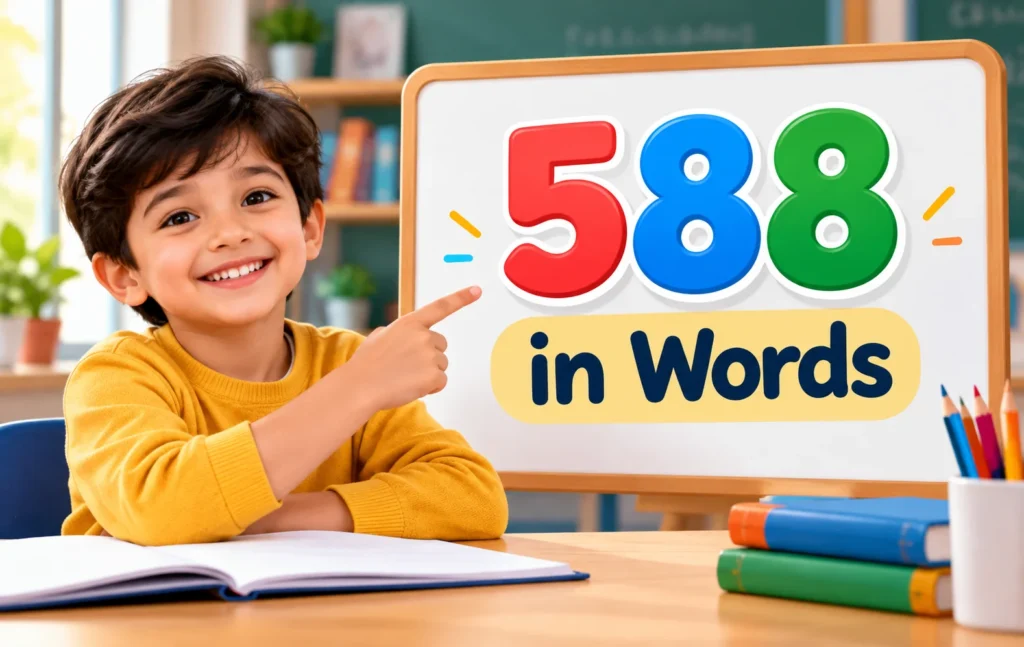
588 in words is five hundred eighty eight.

You’ll find some books adding an “and” (five hundred and eighty eight) and a few American ones joining eighty and eight with a hyphen. Fine, whichever. It’s the same number, and in the end the only style that counts is the one your teacher ticks.

So the answer’s out of the way. What’s left is the how, and that’s where the marks are.

How to Write 588 in Words: Place Value Chart, Expanded Form

Writing It Out

Chop 588 after the hundreds: 5, then 88. Five hundred. Eighty eight.

If I had to pick one bit to drill with a child, it’d be the 88. They know “eight” and they know “eighty”, but put the two together and you get “eight eighty” about as often as the right thing. Tens come first, ones come second. Eighty, then eight.

Then spelling. The “gh” in eighty sits before the “t”, and hundred ends in “dred”. Mess up either of those and the answer is right but the mark isn’t.

Read More: Cube Root of 1000 

Place Value Chart of 588

Hundreds

Tens

Ones

5

8

8

Left to right. Five hundreds, which is 500. Eight tens, which is 80. Eight ones, which is 8. Put them back together and you’ve got 588 again.

The two 8s are what the chart is for. Same digit, but the first one is worth ten times the second. Worksheets ask “what is the value of the first 8 in 588?” and the answer is 80. Write 8 and you’ve given the digit, when they wanted the value.

Expanded Form

500 + 80 + 8.

That’s it, the number pulled apart. Some books want (5 × 100) + (8 × 10) + (8 × 1) instead, and some want it as 5 hundreds + 8 tens + 8 ones. Open your chapter, look at the worked example, and copy the style.

Check by adding back up. 500 plus 80 is 580. Add 8 and you’re at 588. If you’re not, a digit’s in the wrong place.

Words Back to Digits

The other direction comes up too. You’re given “five hundred eighty eight” and asked for the number. Five hundred, so 5 in the hundreds. Eighty, so 8 in the tens. Eight, so 8 in the ones. 588.

Watch for a missing word, though. “Five hundred eight” is 508, because without a tens word there’s a zero in the tens place. Drop a word, drop a digit.

On a Cheque

Banks go by the words. If the words and the figures disagree, the words usually win, which makes this the one place where spelling costs you. Rs 588 is “Five hundred eighty eight rupees only”. The “only” at the end closes the line so nobody can tack something on after it. If there are paise, they’re written as a fraction, like “and 50/100”.

Other Forms of 588

The 588th person in a queue is the “five hundred eighty eighth”. Eight turns into eighth and everything else stays.

In Roman numerals it’s DLXXXVIII, built from D (500), L (50), XXX (30) and VIII (8).

Round it to the nearest ten and you get 590, because the 8 in the ones place pushes the tens up. Round to the nearest hundred and you get 600, because the 8 in the tens place pushes the hundreds from 5 to 6.

Bigger Numbers

Put a word after the same chunk. 1,588 is one thousand five hundred eighty eight, and 5,588 is five thousand five hundred eighty eight. Stick the 588 in front of a thousand and it’s five hundred eighty eight thousand. In front of a million, five hundred eighty eight million.

Indian books put the commas somewhere else. 588,000 is written 5,88,000 and read five lakh eighty eight thousand, and 588,000,000 is written 58,80,00,000 and read fifty eight crore eighty lakh. It’s worth learning the commas with the words, because the two systems don’t line up.

Biggest of Three

Try 585, 588 and 598. Hundreds are all 5, so skip them. Tens are 8, 8 and 9, which makes 598 the winner. Between the other two the tens tie, so the ones decide: 8 beats 5. Smallest to largest, then: 585, 588, 598. If a question throws in 589 as well, it slots between 588 and 598, since it’s only one more than 588. The method never changes: hundreds, then tens, then ones, stopping at the first place where the digits differ.

Counting On from 588

Count in tens from 568 and you pass through 568, 578, 588, 598. Count in hundreds from 88 and it goes 88, 188, 288, 388, 488, 588. Counting like this is a good way to see where 588 sits: well past 500, a bit short of 600, and closer to the 600 end.

A Shop Problem

A shopkeeper has 588 pencils and needs the number in words for his stock register. Five hundred eighty eight pencils. A new box of 12 comes in and he’s up to 600, which is just “six hundred”. The tens and ones words disappeared, because both digits turned into zeros.

Why It's a Place Value Topic

The words look like a spelling job. They’re not. Underneath, it’s a check on whether a child knows that a digit’s worth depends on where it sits. And that’s the same idea that makes carrying work. Take 588 + 12: the ones make 10, so write 0 and carry 1. The tens make 10 as well, so write 0 and carry 1 again. The hundreds make 6. The chart is quietly doing every step.

Other Numbers, Same Trick

345 is three hundred forty five. 712 is seven hundred twelve (twelve has its own word, no “ten two”). 906 is nine hundred six, with no tens word because the tens digit is 0. Hundreds first, then the last two digits as one lump.

Slips

Reading digit by digit: “five eight eight”. Losing the tens word and ending up at 508. “Eigthy”. “Hundrad”. A comma in the middle, as in “five hundred, eighty eight”, which numbers below a thousand don’t need. And treating the two 8s as worth the same.

Practice

  1. Write 588 in words.
  2. What is the value of the first 8 in 588?
  3. What is the value of the second 8?
  4. Write 588 in expanded form.
  5. Write “five hundred eighty eight” as a number.
  6. Round 588 to the nearest ten.
  7. Round 588 to the nearest hundred.
  8. Write 588 in Roman numerals.
  9. Which is greater, 588 or 585?

Answers: 1) five hundred eighty eight. 2) 80. 3) 8. 4) 500 + 80 + 8. 5) 588. 6) 590. 7) 600. 8) DLXXXVIII. 9) 588.

Fill in the Blanks


    1. 588 = ___ hundreds + ___ tens + ___ ones
    2. 588 = 500 + ___ + 8
    3. The number after 588 is ___.
    4. The number before 588 is ___.
    5. 588 + 12 = ___

Answers: 1) 5, 8, 8. 2) 80. 3) 589. 4) 587. 5) 600.

For Parents and Teachers

Sticks do the job. One bundle of 100, some bundles of 10, a handful of loose ones. Build 588 on the table: five big bundles, eight small, eight singles. Ask for the number in words.

Then go the other way. Say a number in words and have the child build it. And if the two 8s get mixed up, ask which one is a bundle and which one is a single stick. That usually settles it.

A Trick for the Exam Hall

When your mind goes blank, draw three small boxes and label them Hundreds, Tens and Ones. Write 5, 8 and 8 under them. Now read each box on its own: five hundred, eighty, eight. Join them up and you’re done. It takes about ten seconds, and you can do it on rough paper without anyone noticing.

Conclusion

Before handing in, read your words against the digits one more time. Look at eighty and hundred. If the paper wants both words and figures, make sure they haven’t ended up in each other’s boxes. Little slips like that cost more marks than not knowing the topic ever does.

588 in words is five hundred eighty eight. In expanded form, 500 + 80 + 8. And the two 8s are worth 80 and 8.

Frequently Asked Questions

Five hundred eighty eight.

British and Indian English often add it, American English often doesn’t. Follow your teacher.

80, since it sits in the tens place.

Want your child to build these skills with an expert mentor?

Find what your child will love learning next.

Live online classes in public speaking, writing, maths and money skills.