Table of contents
- What Is Mental Maths for Kindergarten Children?
- Why Mental Maths Matters in the Early Years
- Easy Mental Maths Question for Child: Examples by Level
- How Mental Math Online Classes for Child Learners Work
- How to Choose the Best Online Mental Maths Classes for Kindergarten
- Why Oratrics Is a Strong Choice for Mental Maths Online Classes
- Simple Ways to Practise Mental Maths at Home
- When Should Your Child Start Mental Maths?
- Frequently Asked Questions
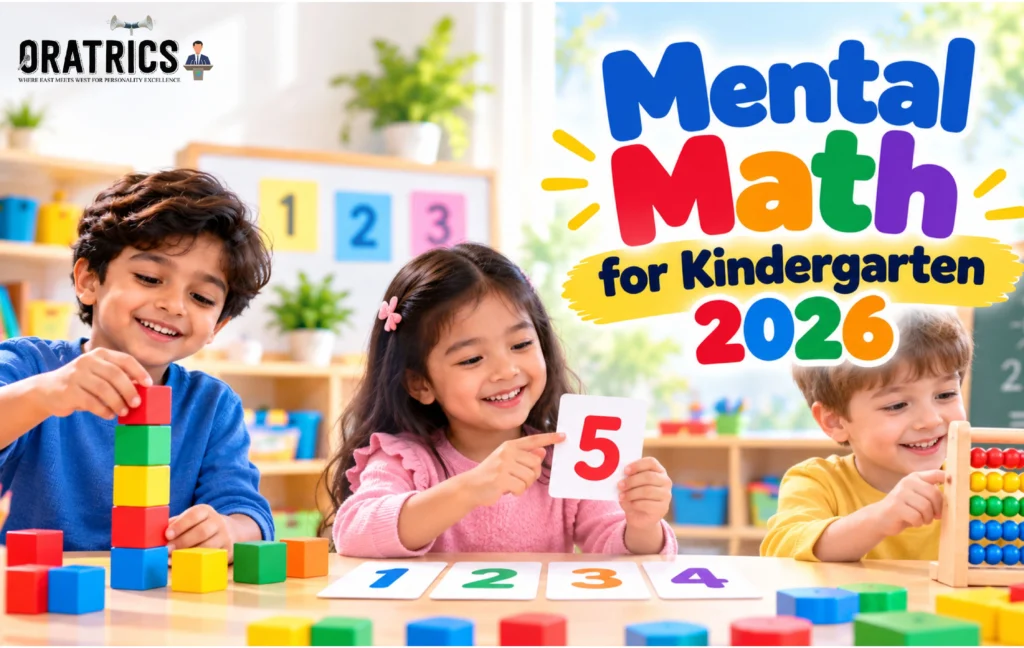
Many parents want their little ones to enjoy numbers instead of fearing them. That is why mental maths for kindergarten 2026 is becoming a popular choice for families who want a strong, stress-free start in maths. With the help of the Oratrics mental math online classes for child, kids aged 4 to 6 can learn how quickly they can add, subtract without using paper.
In this guide, you will find easy mental maths question for child examples, tips to practise at home, a simple checklist for choosing the best online mental maths classes for kindergarten, and a look at how Oratrics supports young learners.
What Is Mental Maths for Kindergarten Children?
The basic meaning of Mental maths is to solve the number with brain no by using paper pen. For a kindergarten child, this does not mean hard sums or speed tests. It means building a friendly feel for numbers through pictures, play and small steps.
At this age, a child may start by picturing three apples and two more apples, and then say “five.” Over time, this habit turns into quick, confident thinking.
Simple mental maths skills for little ones include:
- Counting forward and backward
- Knowing which number is bigger or smaller
- Adding and subtracting small numbers
- Spotting number patterns
- Understanding pairs that make 10
- Visualising numbers instead of using fingers
Why Mental Maths Matters in the Early Years
The early years are when children form their first feelings about maths. If numbers feel like a game, the child grows curious. If they feel like pressure, the child may avoid them later.
Regular, playful mental maths practice can help children:
- Build number sense: They understand what numbers mean, not just how they look.
- Improve focus: Thinking without a pen or calculator trains attention.
- Grow confidence: Each correct answer makes a child feel capable.
- Strengthen memory: Holding numbers in mind exercises working memory.
- Prepare for school: Primary classes become easier when basics feel natural.
Every child learns at a different pace. The goal is steady progress, not racing ahead of others.
Read More: Mental Maths for Class 1
Easy Mental Maths Question for Child: Examples by Level
Parents often ask what kind of mental maths question for child learners is suitable at this age. Keep questions short, visual and fun. Here are some examples you can try at home.
Skill | Sample Question | Tip for Parents |
Counting | What comes after 7? | Use toys or snacks to count along |
Counting backward | Count back from 10 to 1. | Turn it into a rocket launch game |
Bigger or smaller | Which is more, 6 or 4? | Show two piles of blocks |
Simple addition | 2 apples and 3 apples. How many in all? | Draw or picture the apples |
Simple subtraction | You have 5 balloons and 2 fly away. How many are left? | Act it out with real balloons |
Making 10 | 7 and what makes 10? | Use a ten-frame or fingers at first |
Patterns | 2, 4, 6, what comes next? | Clap the pattern together |
Start with one or two questions a day. Stop while your child is still enjoying it, so they look forward to the next time.
How Mental Math Online Classes for Child Learners Work
In a good online class for kindergarten, learning looks like play. A trained mentor guides the child through short, live activities on screen.
A typical session may include:
- A warm-up with counting songs or number games
- A visual activity, such as picture-based adding
- Quick, friendly mental maths questions
- A small challenge or puzzle
- Praise and encouragement to end on a high
The sessions stay short because young children focus best in small bursts. Interaction matters too. When a child answers aloud and the mentor responds right away, learning sticks better than watching a recorded video.
Benefits of Learning Online
- Learn from home: Children feel relaxed in a familiar space.
- No travel: Classes fit around school and rest time.
- Parent involvement: You can sit nearby and see how your child learns.
- Flexible timing: Many programs offer more than one batch.
- Choice of mentors: You are not limited to what is near your home.
How to Choose the Best Online Mental Maths Classes for Kindergarten
Before you enrol, check these points. They help you find the best online mental maths classes for kindergarten for your child’s needs.
What to Check | Why It Matters | Good Sign |
Age-friendly design | Small children need play, not pressure | Activities made for ages 4 to 6 |
Live interaction | Kids learn by answering and talking | Real-time, two-way classes |
Trained mentors | Patient teachers build trust | Mentors experienced with young learners |
Small batches | Each child gets more turns | Limited seats per class |
Clear goals | You know what your child will learn | Defined skills and progress updates |
Visual teaching | Young minds think in pictures | Use of images, games and stories |
Trial class | Helps your child feel comfortable first | Demo before payment |
Watch your child during a trial. A smile, eagerness to answer and talking about the class afterwards are good signs.
Why Oratrics Is a Strong Choice for Mental Maths Online Classes
Oratrics is an ed tech platform that helps children build skills through live online learning. Its mental maths classes for young learners are designed to make numbers feel like a game, so children build confidence along with calculation skills.
What Your Child Can Expect
- Live, interactive online sessions with a guiding mentor
- Playful, picture-based activities suited to kindergarten age
- Regular mental maths practice that grows step by step
- A supportive space where every child is encouraged to answer
- Progress shared with parents so you can help at home
How Oratrics Compares with Other Options
Many programs rely on recorded videos, worksheets or one plan for every age. Here is how Oratrics differs.
Feature | Typical Generic Program | Oratrics |
Teaching style | Recorded videos or heavy worksheets | Live, interactive, activity-led sessions |
Age fit | Same content for all ages | Content matched to the child’s stage |
Child comfort | Can feel rushed or stressful | Playful and encouraging |
Parent involvement | Little feedback | Parents kept informed on progress |
Learning goal | Speed and marks | Understanding, confidence and enjoyment |
The main difference is the approach: Oratrics focuses on helping children understand numbers and enjoy thinking, instead of pushing for speed too early.
Simple Ways to Practise Mental Maths at Home
Classes work best when practice continues in daily life. Try these easy ideas:
- Count everyday things: Stairs, toys, fruits or steps to the door.
- Play with dice or cards: Add the numbers that come up.
- Use songs and rhymes: Number rhymes make counting stick.
- Make shopping a game: Ask how many items are in the basket.
- Keep it short: Five to ten minutes of fun is enough.
When Should Your Child Start Mental Maths?
Most children are ready to begin around age 4 or 5, once they can count a few numbers and follow simple instructions. If your child enjoys counting games and asks number questions, it is a good time to start. If they are still learning basic counting, begin with play at home and add classes when they feel ready.
Frequently Asked Questions
Children around 4 to 6 years can begin, as long as the learning is play-based and short. Start with counting and number games before moving to simple adding and subtracting.
They can be, when the sessions are live, interactive and led by a trained mentor in small groups. Regular practice at home helps your child keep and use what they learn.
Look for age-appropriate activities, live interaction, small batches, clear learning goals and a trial class. Choose a program that makes your child feel happy and confident, not stressed.
Oratrics offers live, child-friendly sessions that use play and visuals to build number sense and confidence, with parents kept updated on progress.
Want your child to build these skills with an expert mentor?