Table of contents
- What Is the Square of a Number?
- Square of 1 to 50: Complete List
- Square of 1 to 50 Chart
- Easy Tricks to Remember Squares from 1 to 50
- Easy Tricks to Remember Squares from 1 to 50
- Important Patterns in Square Numbers
- Square 1 to 60
- Square 1 to 70
- Square 1 to 100
- How to Calculate Squares Without Memorizing Them
- Why Should Students Learn Squares from 1 to 50?
- Common Mistakes While Learning Square Numbers
- Practice Questions on Squares from 1 to 50
- Conclusion
- Frequently Asked Questions
Knowing the square of 1 to 50 by heart makes maths faster and far less stressful. It helps in arithmetic, algebra, geometry, mental maths, competitive exams, and everyday calculations like finding the area of a room. This guide gives you the full list and a quick-reference chart. It also teaches memory tricks that rely on patterns, not rote learning. Once you are comfortable here, you can move on to the Square of 1 to 100 using the same ideas.
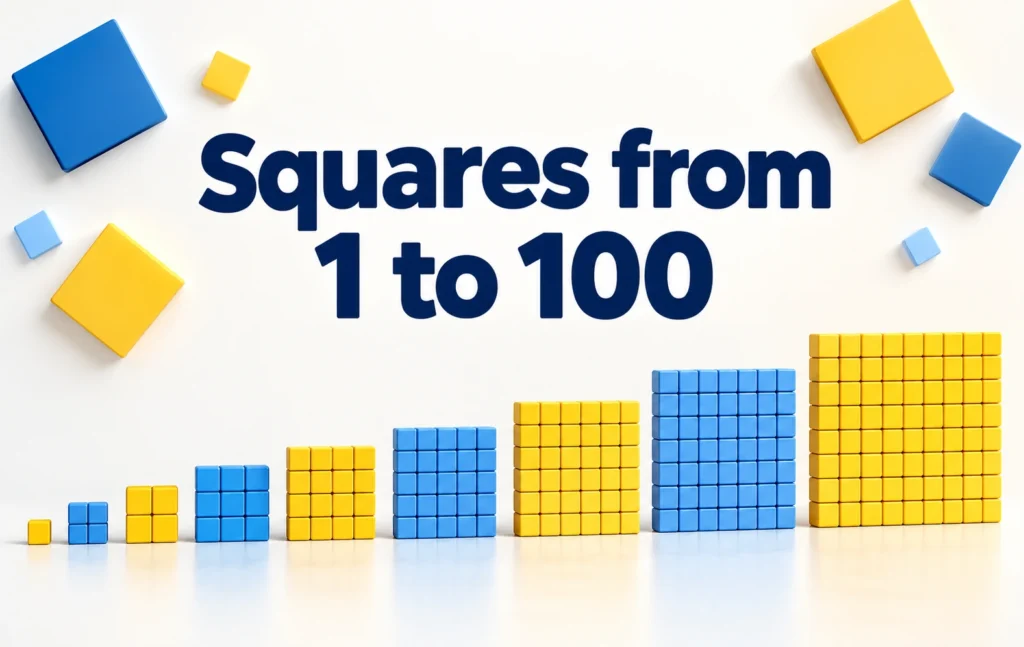
What Is the Square of a Number?
The square of a number is the result of multiplying that number by itself.
The formula is:
n² = n × n
Read n² as “n squared.”
- 5² = 5 × 5 = 25
- 10² = 10 × 10 = 100
- 20² = 20 × 20 = 400
A perfect square is a whole number that is the square of another whole number. So 25 is a perfect square because 5 × 5 = 25, but 26 is not, because no whole number multiplied by itself gives 26.
The name comes from geometry. A square with sides of 5 units has an area of 5 × 5 = 25 square units.
Square of 1 to 50: Complete List
Number | Square | Number | Square |
1 | 1 | 26 | 676 |
2 | 4 | 27 | 729 |
3 | 9 | 28 | 784 |
4 | 16 | 29 | 841 |
5 | 25 | 30 | 900 |
6 | 36 | 31 | 961 |
7 | 49 | 32 | 1024 |
8 | 64 | 33 | 1089 |
9 | 81 | 34 | 1156 |
10 | 100 | 35 | 1225 |
11 | 121 | 36 | 1296 |
12 | 144 | 37 | 1369 |
13 | 169 | 38 | 1444 |
14 | 196 | 39 | 1521 |
15 | 225 | 40 | 1600 |
16 | 256 | 41 | 1681 |
17 | 289 | 42 | 1764 |
18 | 324 | 43 | 1849 |
19 | 361 | 44 | 1936 |
20 | 400 | 45 | 2025 |
21 | 441 | 46 | 2116 |
22 | 484 | 47 | 2209 |
23 | 529 | 48 | 2304 |
24 | 576 | 49 | 2401 |
25 | 625 | 50 | 2500 |
Square of 1 to 50 Chart
Use this compact chart for quick revision, homework, and exam preparation.
1–10 | 11–20 | 21–30 | 31–40 | 41–50 |
1² = 1 | 11² = 121 | 21² = 441 | 31² = 961 | 41² = 1681 |
2² = 4 | 12² = 144 | 22² = 484 | 32² = 1024 | 42² = 1764 |
3² = 9 | 13² = 169 | 23² = 529 | 33² = 1089 | 43² = 1849 |
4² = 16 | 14² = 196 | 24² = 576 | 34² = 1156 | 44² = 1936 |
5² = 25 | 15² = 225 | 25² = 625 | 35² = 1225 | 45² = 2025 |
6² = 36 | 16² = 256 | 26² = 676 | 36² = 1296 | 46² = 2116 |
7² = 49 | 17² = 289 | 27² = 729 | 37² = 1369 | 47² = 2209 |
8² = 64 | 18² = 324 | 28² = 784 | 38² = 1444 | 48² = 2304 |
9² = 81 | 19² = 361 | 29² = 841 | 39² = 1521 | 49² = 2401 |
10² = 100 | 20² = 400 | 30² = 900 | 40² = 1600 | 50² = 2500 |
Easy Tricks to Remember Squares from 1 to 50
1. Master 1 to 10 first
Every larger square builds on these ten: 1, 4, 9, 16, 25, 36, 49, 64, 81, 100. Practise them until they feel automatic. Most mistakes with bigger squares come from a shaky foundation here.
2. Use the difference between consecutive squares
Look at the first few squares: 1, 4, 9, 16, 25. The gaps between them are 3, 5, 7, 9. These are consecutive odd numbers. This happens because of the identity:
(n + 1)² = n² + 2n + 1
In simple words, to get the next square, add 2n + 1 to the current one. For example, to go from 7² to 8²: 49 + (2 × 7 + 1) = 49 + 15 = 64.
3. Squares of numbers ending in 5
Follow these steps:
- Take the digit(s) before the 5. For 35, that is 3.
- Multiply it by the next whole number. 3 × 4 = 12.
- Write 25 after it. The answer is 1225.
Number | Multiply | Square |
15 | 1 × 2 = 2 | 225 |
25 | 2 × 3 = 6 | 625 |
35 | 3 × 4 = 12 | 1225 |
45 | 4 × 5 = 20 | 2025 |
4. Use nearby round numbers
Round numbers are easy to square, so step off from them.
- 19² = (20 − 1)² = 400 − 40 + 1 = 361
- 31² = (30 + 1)² = 900 + 60 + 1 = 961
- 49² = (50 − 1)² = 2500 − 100 + 1 = 2401
5. Practise in groups of 10
Learn in chunks: 1–10, 11–20, 21–30, 31–40, 41–50. Short groups feel manageable, and you can revise one group a day. By the end of the week, you will know the whole list.
Important Patterns in Square Numbers
- Squares of even numbers are even. Example: 6² = 36, 14² = 196.
- Squares of odd numbers are odd. Example: 7² = 49, 13² = 169.
- A perfect square never ends in 2, 3, 7, or 8. Squares end only in 0, 1, 4, 5, 6, or 9.
- Consecutive squares differ by consecutive odd numbers. Example: 16 − 9 = 7 and 25 − 16 = 9.
- Numbers ending in 5 always have squares ending in 25. Example: 15² = 225, 45² = 2025.
Here is the last-digit pattern in full:
Number ends in | Square ends in |
1 or 9 | 1 |
2 or 8 | 4 |
3 or 7 | 9 |
4 or 6 | 6 |
5 | 5 |
0 | 0 |
This is a handy way to check your answers. If you get 23² = 528, the last digit is wrong, because a number ending in 3 must have a square ending in 9. The correct answer is 529.
Square 1 to 60
If you have mastered squares up to 50, extending to 60 is easy. The same patterns still work. Here are the next ten:
Number | Square |
51 | 2601 |
52 | 2704 |
53 | 2809 |
54 | 2916 |
55 | 3025 |
56 | 3136 |
57 | 3249 |
58 | 3364 |
59 | 3481 |
60 | 3600 |
Notice that 55² = 3025 follows the “ending in 5” trick: 5 × 6 = 30, then 25.
Square 1 to 70
Squares up to 70 are useful in mental maths and competitive exams, where larger values appear often in aptitude sections.
Number | Square |
61 | 3721 |
62 | 3844 |
63 | 3969 |
64 | 4096 |
65 | 4225 |
66 | 4356 |
67 | 4489 |
68 | 4624 |
69 | 4761 |
70 | 4900 |
Tip: 64² = 4096 is worth remembering because 64 is 2⁶ and 4096 is 2¹².
Square 1 to 100
A complete Square 1 to 100 chart is a strong reference for higher-level calculations and exams. You already have 1 to 70 above, so here is the rest.
Number | Square | Number | Square | Number | Square |
71 | 5041 | 81 | 6561 | 91 | 8281 |
72 | 5184 | 82 | 6724 | 92 | 8464 |
73 | 5329 | 83 | 6889 | 93 | 8649 |
74 | 5476 | 84 | 7056 | 94 | 8836 |
75 | 5625 | 85 | 7225 | 95 | 9025 |
76 | 5776 | 86 | 7396 | 96 | 9216 |
77 | 5929 | 87 | 7569 | 97 | 9409 |
78 | 6084 | 88 | 7744 | 98 | 9604 |
79 | 6241 | 89 | 7921 | 99 | 9801 |
80 | 6400 | 90 | 8100 | 100 | 10000 |
The perfect squares from 1 to 100 are 1, 4, 9, 16, 25, 36, 49, 64, 81, and 100.
Square 50 to 100
Here is a compact reference for Square 50 to 100, arranged for easy scanning.
Number | Square | Number | Square | Number | Square |
50 | 2500 | 67 | 4489 | 84 | 7056 |
51 | 2601 | 68 | 4624 | 85 | 7225 |
52 | 2704 | 69 | 4761 | 86 | 7396 |
53 | 2809 | 70 | 4900 | 87 | 7569 |
54 | 2916 | 71 | 5041 | 88 | 7744 |
55 | 3025 | 72 | 5184 | 89 | 7921 |
56 | 3136 | 73 | 5329 | 90 | 8100 |
57 | 3249 | 74 | 5476 | 91 | 8281 |
58 | 3364 | 75 | 5625 | 92 | 8464 |
59 | 3481 | 76 | 5776 | 93 | 8649 |
60 | 3600 | 77 | 5929 | 94 | 8836 |
61 | 3721 | 78 | 6084 | 95 | 9025 |
62 | 3844 | 79 | 6241 | 96 | 9216 |
63 | 3969 | 80 | 6400 | 97 | 9409 |
64 | 4096 | 81 | 6561 | 98 | 9604 |
65 | 4225 | 82 | 6724 | 99 | 9801 |
66 | 4356 | 83 | 6889 | 100 | 10000 |
How to Calculate Squares Without Memorizing Them
If you forget a value, you can always work it out.
Method 1: Direct multiplication
Multiply the number by itself.
24² = 24 × 24 = 576
Method 2: Using (a + b)²
(a + b)² = a² + 2ab + b²
Split the number into a round number plus a small number.
32² = (30 + 2)²
= 900 + 120 + 4
= 1024
Method 3: Using (a − b)²
(a − b)² = a² − 2ab + b²
Use this when the number is just below a round number.
49² = (50 − 1)²
= 2500 − 100 + 1
= 2401
Why Should Students Learn Squares from 1 to 50?
- Faster mental calculation: quick recall saves time in exams.
- Easier algebra: expressions like x² and identities like (a + b)² become less intimidating.
- Square roots: if you know 36 = 6², you instantly know √36 = 6.
- Geometry: area of squares and many formulas use squares.
- Pythagorean theorem: a² + b² = c² relies on squares. For example, 3² + 4² = 9 + 16 = 25 = 5².
- Competitive exams and aptitude tests: squares appear constantly in number series and data questions.
- Better number sense: you start to see how numbers relate to each other.
Common Mistakes While Learning Square Numbers
- Confusing square with double. 8² is 64, not 16. Squaring means multiplying by itself, not by 2.
- Writing 12² as 12 × 2. The correct working is 12 × 12 = 144.
- Mixing up nearby values. Students often swap 17² = 289 and 19² = 361. Use the last-digit pattern to check.
- Memorizing without understanding. Pure rote learning fades quickly. Learn one pattern for each group.
- Calculation slips with larger numbers. Use the (a ± b)² method and double-check the last digit.
Practice Questions on Squares from 1 to 50
- What is 14²?
- Find the square of 27.
- What is 35²?
- Which number has a square of 1600?
- Calculate 49² without direct multiplication.
- What is 18²?
- Find 41².
- What is 23²?
- Find the number whose square is 2025.
- Calculate 29² using a nearby round number.
- What is 48²?
- What is the difference between 30² and 29²?
- Is 1000 a perfect square? Between which two squares does it lie?
Answers
- 196
- 729
- 1225
- 40
- (50 − 1)² = 2500 − 100 + 1 = 2401
- 324
- 1681
- 529
- 45
- (30 − 1)² = 900 − 60 + 1 = 841
- 2304
- 900 − 841 = 59, which equals 2 × 29 + 1
- No. It lies between 31² = 961 and 32² = 1024.
Conclusion
Learning the square of 1 to 50 is one of the most useful habits in school maths. Start with 1 to 10, study in groups, and lean on the patterns: odd gaps, endings in 5, and round-number shortcuts. When you understand why a square works, you will remember it far longer than if you only memorize the table. Revise a group each day, test yourself with the practice questions, and you will be ready to extend to 100.
Frequently Asked Questions
It is the list of squares from 1² = 1 up to 50² = 2500, shown in the table above.
Learn 1 to 10 first, then study in groups of 10. Use patterns like the “ending in 5” trick and the (a ± b)² method.
50² = 50 × 50 = 2500.
First master 1 to 50, then add 51 to 100 in groups of 10. Use round-number shortcuts, such as 98² = (100 − 2)² = 9604.
1, 4, 9, 16, 25, 36, 49, 64, 81, and 100.
Squaring multiplies a number by itself (6² = 36). A square root reverses this (√36 = 6).
They speed up mental calculation and support algebra, geometry, and exam problem solving.
Start with 1² to 10², then 11² to 20², since these are used most often.
Split the number around a round number and apply (a + b)² or (a − b)². For example, 47² = (50 − 3)² = 2500 − 300 + 9 = 2209.
Want your child to build these skills with an expert mentor?